Scărișoara Cave, also known as the Scărișoara Ice Cave, is one of the most famous and most visited caves in Romania. It holds a spectacular underground glacier, considered to be one of the largest and oldest underground glaciers in the world.
Scărișoara Cave
In this article
Location and Access
Scărișoara Cave is located in Alba County, in the Apuseni Mountains, near the village of Ghețari in the Gârda de Sus commune.
The name comes from the commune of Scărișoara, about 16 km away, to which the cave used to belong.
Located at an altitude of about 1,165 meters, the cave is surrounded by a picturesque mountain landscape with dense forests and karst terrain. It was carved by the waters of the Ocoale Valley.
Routes and means of transportation to Scărișoara Cave
To reach Scărișoara Cave, tourists can follow several routes, depending on their starting point.
From Cluj-Napoca, you can drive on the DN1R (via Huedin and Albac) and then the DN75 to Gârda de Sus, and from Alba Iulia on the DN74 to Abrud and then, via Câmpeni, on the DN75. From Gârda de Sus, the road continues on a paved stretch of about 10 km to the village of Ghețari.
You can also choose the Transapuseana route.
For those who prefer public transportation, there are buses and minibuses connecting the major cities with the nearby villages.
Cars are parked in the village of Ghețari, from where you continue on foot to the cave.
The attraction is about 110 km from Turda and nearly 130 km from Alba Iulia.
Visiting hours
Scărișoara Cave is open to visitors year-round, except during periods when extreme weather makes access difficult.
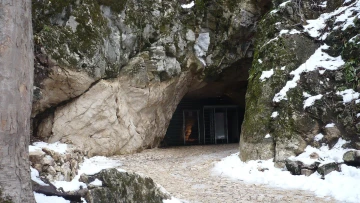
Scărișoara Cave entrance
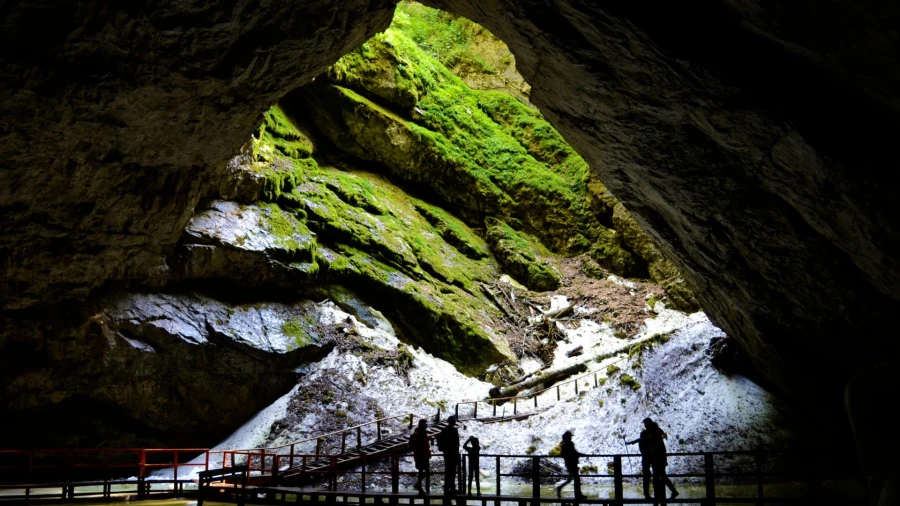
Visiting hours vary by season; the cave is usually open from 10 a.m. to 6 p.m. in the summer season and from 10 a.m. to 4 p.m. in the winter season.
Admission tickets are affordable, with discounts for children and students.
Visitors are advised to dress appropriately for the low temperatures inside the cave and to follow the rules in place to protect this natural monument.
History and Discovery
Who discovered the cave and when
Scărișoara Cave and its glacier were known to locals before the first documented scientific research, which dates back to the mid-19th century: the first written mention is from 1847, and the geologist Karl Peters published the first scientific observations in 1861.
In 1863, the Austrian geographer Adolf Schmidl published a detailed description of the glacier, together with the first map of the cave and two cross-sections.
The cave's popularization within the international scientific community is largely owed to Schmidl and to later research by Romanian and foreign speleologists and geologists.
The evolution of research and exploration of the cave over time
Over time, Scărișoara Cave has been the subject of numerous expeditions and speleological studies.
In the first half of the 20th century, research was taken further by Emil Racoviță, one of the founders of biospeleology. Racoviță visited the cave five times between 1921 and 1923, and his results, published in 1927, contributed significantly to the understanding of how the ice forms and of the interior climate.
Scărișoara Cave
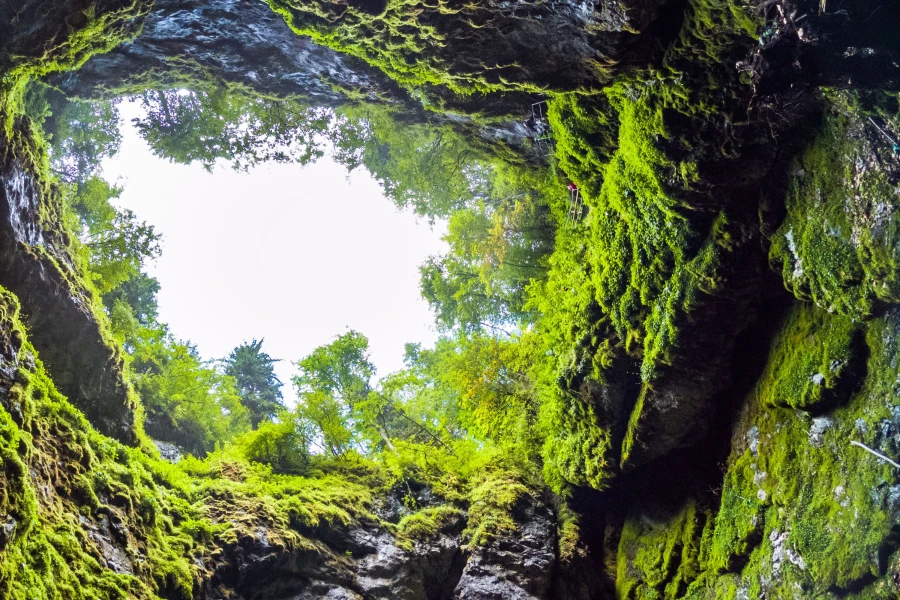
In recent decades, research has continued, focusing on climate and paleoclimate studies, thanks to the glacier, whose layers preserve valuable information about the environment over the millennia.
Important figures and events connected to the cave
Besides Adolf Schmidl and Emil Racoviță, other notable figures who contributed to the exploration and study of Scărișoara Cave include the speleologists Maxim Pop, Mihai Șerban, Iosif Viehmann, Gheorghe Racoviță, and Teodor Rusu, and, in recent decades, the researcher Aurel Perșoiu.
In 1938, the cave became the first in Romania to be declared a natural monument, an important moment in the recognition and protection of this unique place.
International speleological events hosted here, such as the 11th International Workshop on Ice Caves (IWIC) in February 2026, and the involvement of researchers from the Emil Racoviță Institute of Speleology have also helped raise the cave's profile worldwide.
Description of the Cave
Structure of the cave (dimensions, sections)
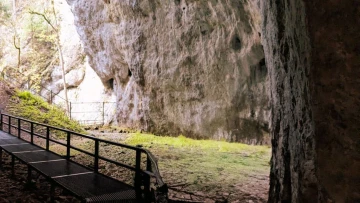
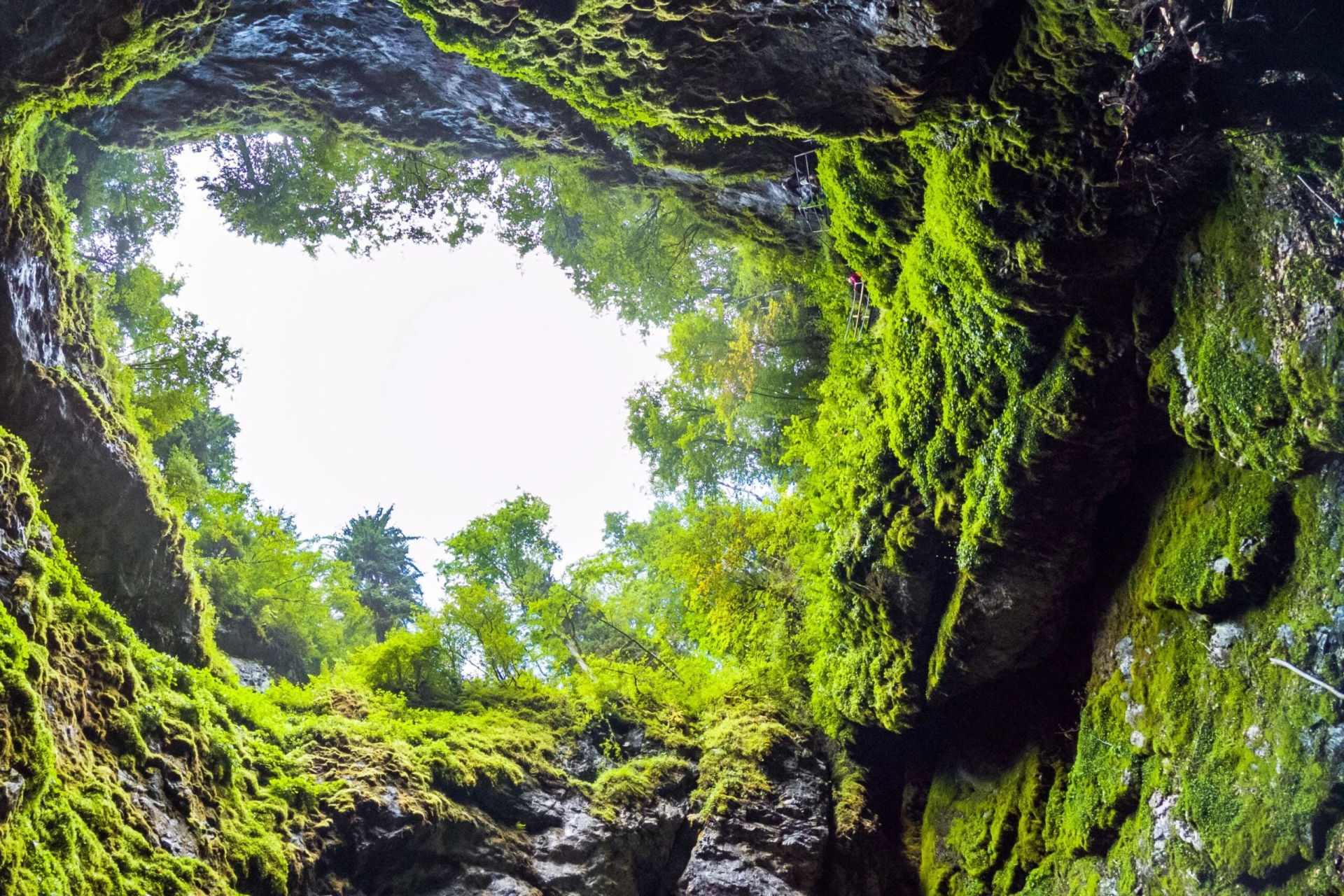
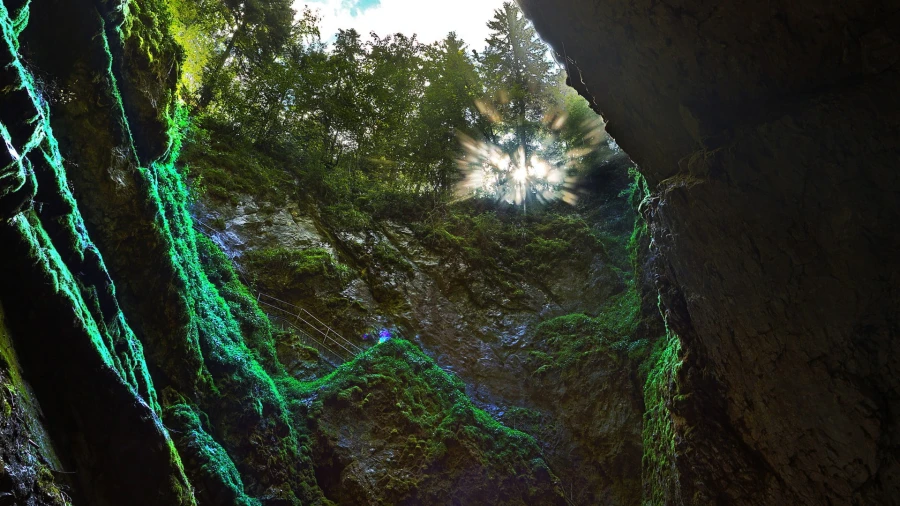
Visiting Scărișoara Ice Cave involves descending from the edge of the plateau on anchored metal stairs into a huge shaft 60 m in diameter and 48 m deep.
Scărișoara Cave has a total length of about 720 meters, with a maximum depth of 105 meters.
The main attraction is the Great Hall, where the glacier is located, a block of ice with an estimated volume of more than 75,000 cubic meters. The hall is about 108 meters long and 78 meters wide.
The cave consists of several sections and galleries, including:
The Church
The Church is the cave's tourist area, on the right side of the Great Hall, where the ice floor drops down a steep slide.
Ice stalagmites: This is where the first ice stalagmites appear, more than 100 of them, changing shape and size from one season to the next.
The Little Reserve
The Little Reserve lies to the right of the entrance, at the bottom of a 15 m vertical drop between rock and ice.
Access: It is closed to tourists, being reserved for scientific research, and also holds ice stalagmites.
The Great Reserve
The Great Reserve lies to the left of the entrance, at the bottom of a 20 m vertical drop, and is accessible only to researchers.
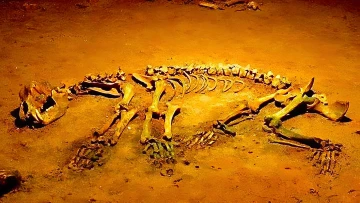
Cave formations: This section holds ice stalagmites, and the skeleton of a chamois was discovered here.
Coman Gallery
Coman Gallery is a narrow extension of the Great Reserve that descends steeply to the cave's maximum depth of 105 m.
Accessibility: It is closed to tourists and holds most of the cave's calcite formations: stalactites, stalagmites, columns, and draperies.
You can visit part of the cave, as some sections are reserved for researchers.
Geological formations and speleothems (stalactites, stalagmites, columns)
Scărișoara Cave is rich in impressive ice and geological formations. In the Church chamber, visitors can admire the spectacular ice stalagmites, whose shape and size create an underground landscape of rare beauty.
Scărișoara Ice Cave
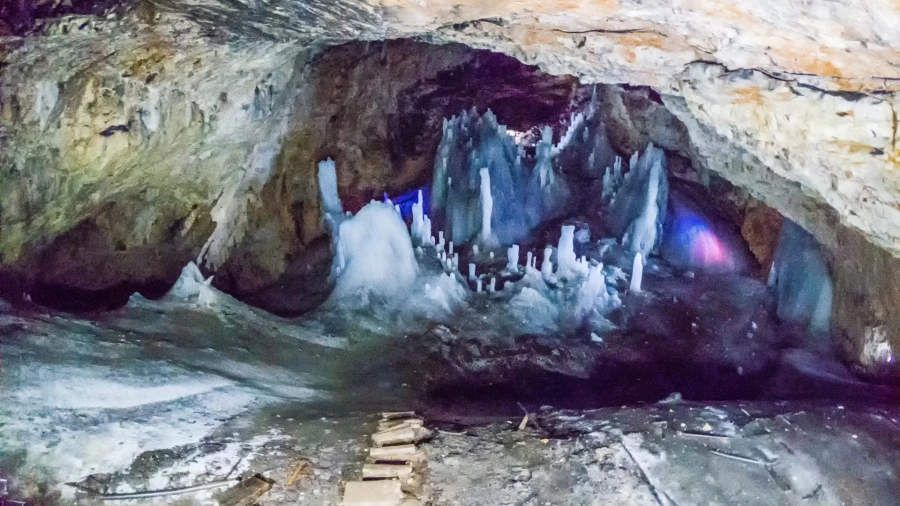
There are also calcite formations, and in some places, ice columns add a special charm to the cave landscape.
Temperature and interior climate of the cave
The temperature inside Scărișoara Cave is constantly low, staying around 0 degrees Celsius in the glacier area, about 9 degrees lower than in Polovragi Cave. Relative humidity is very high.
It varies slightly in other parts of the cave but always stays cold, helping preserve the ice year-round.
The cave's interior climate is stable and humid, and together with the low temperature, it creates ideal conditions for preserving and studying the glacier and the cave formations.
The importance and uniqueness of this cave in a national and international context
Scărișoara Cave is not only a natural monument of remarkable beauty but also a place of great scientific importance.
The underground glacier, at least 10,500 years old, gives researchers valuable information about the region's past climate and the evolution of the natural environment.
Internationally, the cave is recognized for the impressive size of its glacier and for the unique climatic conditions that keep the ice preserved year-round.
These features make Scărișoara Cave a reference site for speleology and paleoclimatology studies.
The Scărișoara Glacier
Glacier in Scărișoara Cave
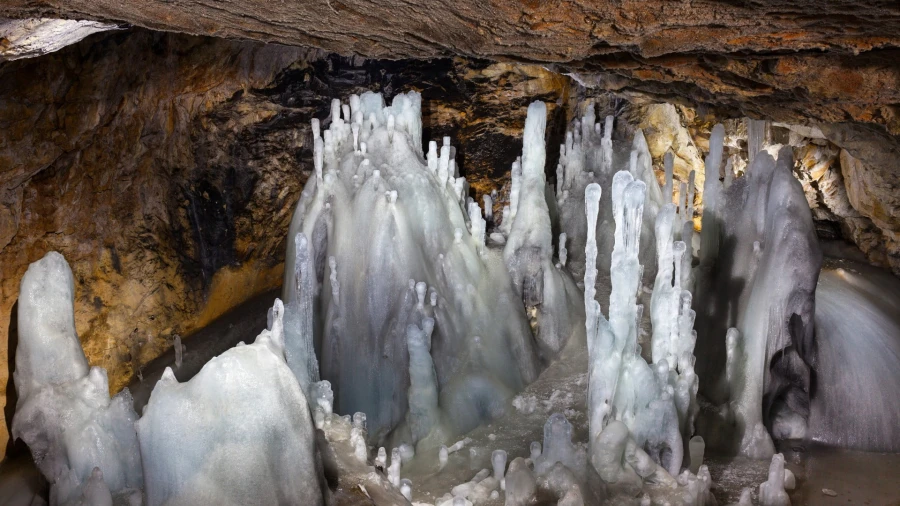
A detailed look at the underground glacier (size, age)
The Scărișoara Glacier is one of the largest underground glaciers in the world, with an impressive volume estimated at more than 75,000 cubic meters.
It occupies the cave's Great Hall, covering an area of about 3,000 square meters, with a thickness of up to 36 meters. Radiocarbon dating of leaves and wood fragments trapped in the ice shows that the oldest layers are at least 10,500 years old.
The ice layers form through the yearly accumulation of water from melting snow and precipitation, which then freezes inside the cave.
Scientific explanations of how the glacier formed and is maintained
The formation of the Scărișoara glacier is the result of specific geological and climatic conditions.
The cave has a vertical opening through which cold air enters in winter and remains trapped inside, maintaining a constantly low temperature.
Ice accumulates as surface water seeps in and, on contact with the cold air in the cave, freezes and forms successive layers of ice.
The glacier survives because, in summer, the cold, dense air in the cave does not mix with the warm air outside, and the melting ice keeps the temperature close to 0 degrees.
The glacier's importance in climate and speleological studies
The Scărișoara glacier is an extremely valuable subject of study for researchers in climatology and speleology.
The ice layers preserve the isotopic composition of the water they formed from, as well as pollen and plant remains, which offer clues about past temperatures, precipitation sources, and vegetation.
The glacier thus works as a natural archive, allowing scientists to reconstruct the region's climate history over thousands of years.
Studies of the glacier also contribute to understanding how underground ice forms and to the conservation of other similar glaciers around the world.
Biodiversity
Although the environmental conditions in Scărișoara Cave are extreme, it is home to a unique underground ecosystem.
Flora and fauna of the cave
Life in the ice consists mainly of microbial communities that can survive in darkness and low temperatures, while the walls of the entrance shaft, where light reaches, host a varied flora arranged in levels.
The cave's fauna is poor but includes species adapted to the cave environment, such as tiny beetles just 2–3 mm long and bats that use the cave as a shelter.
Characteristic and protected species
The most notable representative of the cave fauna here is the beetle Pholeuon proserpinae glaciale, described by the French entomologist René Jeannel.
These species are especially important for the cave's biodiversity and ecological balance and are protected by the cave's nature reserve status. Conserving their habitat is essential for maintaining biodiversity and for continuing scientific research.
Nearby attractions
Ordâncușa Gorges
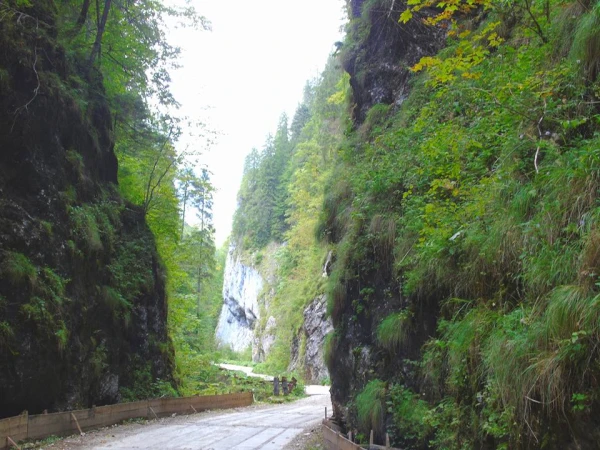
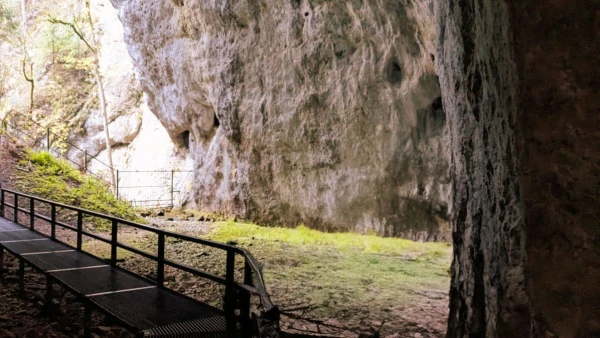
Near Scărișoara Ice Cave there are other interesting tourist attractions, from traditional villages and spectacular gorges to nature reserves and historical monuments. Here are some of them:
Cotețul Dobreștilor Karst Spring: A karst spring in Apuseni Natural Park, where an underground stream comes to the surface.
The Little Church of Gârda: A wooden church built in the 18th century, a historical and folk architecture monument.
Poiana Călineasa: A mountain clearing at 1,300–1,400 m, where the Moți move their households and animals in summer, living in simple wooden huts.
Ordâncușa Gorges: A nature reserve with steep rock walls, many grottoes and caves, and a natural bridge.
Poarta lui Ionele Cave: A cave developed for visitors, with travertine cascades and rimstone pools.
Ghețarul de la Vârtop Cave: A natural monument near Arieșeni, where a Neanderthal footprint at least 62,000 years old was discovered.
Cetățile Ponorului: Known as the Everest of speleology in Romania, a landmark karst complex in the Apuseni Mountains.
Ursoaia Pass: Located on the DN1R at about 1,300 meters, it offers a superb panorama of the Apuseni Mountains.
Pișoaia Waterfall in Vidra commune, a spectacular cascade.
Accommodation
For visitors to Scărișoara Ice Cave, the area offers a variety of accommodation options to suit every preference and budget.
You can choose between local guesthouses and chalets close to the cave, such as Scărișoara Guesthouse and Ghețari Chalet, which offer comfort and an authentic mountain atmosphere. Accommodation in Albac and Gârda de Sus also offers modern facilities and easy access to other attractions in the Apuseni Mountains.
For those who prefer camping and rustic experiences, there are campsites and mountain chalets in the area.
Another attractive option is staying in guesthouses and farm stays in nearby villages, such as those in Arieșeni and Ghețari, where you can experience local hospitality and rural life.
Whatever you choose, it is a good idea to book in advance, especially during the peak tourist season, and to check the facilities offered by each property. Many places offer additional tourist activities, ensuring a pleasant and memorable stay in the heart of the Apuseni Mountains.
Weather
The weather now in Gârda de Sus and the forecast for the next 7 days:
Tourism and Education
The impact of tourism on the cave
Scărișoara Cave attracts tens of thousands of visitors every year thanks to its natural beauty and impressive underground glacier.
However, the constant flow of tourists can have a significant impact on the cave's fragile environment. Heavy traffic can lead to the degradation of geological formations, pollution, and disruption of the ecological balance.
To minimize these effects, the authorities and the cave administration implement protection measures, such as allowing visits only along the developed route, the presence of authorized guides, and closing the areas reserved for research to the public.
Educational programs and conservation projects
Education and public awareness are essential for protecting Scărișoara Cave. Various educational programs are organized to inform visitors about the importance of conserving this natural heritage.
These programs include guided tours that explain how the glacier formed, the cave's biodiversity, and the necessary protection measures.
Conservation projects, carried out in collaboration with research institutions and non-governmental organizations, focus on monitoring the condition of the glacier and the underground ecosystem. Increasingly mild winters and rain in the warm season are speeding up the melting of the glacier, now at its fastest rate in 100 years.
Tourist activities and tips for visitors
Visitors to Scărișoara Cave can take part in a range of activities that let them explore and better understand this unique natural environment.
Guided tours are essential for an informative and safe experience, offering detailed explanations of the cave's geology and the glacier's formation. Photographing and observing the ice and limestone formations are popular activities, but they must be done with respect for the conservation rules.
Tips for visitors:
Follow the guides' instructions and the visiting rules: This includes keeping quiet, avoiding touching the formations, and disposing of waste in designated areas.
Dress appropriately: The cave is cold, so dress accordingly and wear non-slip shoes.
Stay on the developed route: The wooden walkways and steps can be slippery, and the areas off the route are reserved for research.
Plan your visit in advance: Check the visiting hours and access conditions, especially during periods of bad weather.
By following these tips and taking part in educational programs, visitors help protect Scărișoara Cave, ensuring its preservation for future generations.
Conservation and Protection
Measures to protect the cave and the glacier
Scărișoara Cave and its underground glacier are protected by a series of strict measures to ensure the conservation of this natural monument.
Measures are in place for constant monitoring of the glacier and the cave formations, including temperature and humidity sensors installed by researchers to track the cave's climate.
Environmental problems and solutions implemented
One of the main environmental problems facing Scărișoara Cave is the impact of climate change, which can affect the temperature and humidity in the cave, endangering the underground glacier.
To counter these effects, ongoing studies are carried out to better understand the glacier's dynamics and to develop effective conservation strategies.
Conclusion
Scărișoara Cave is a natural monument of exceptional importance, holding one of the largest and oldest underground glaciers in the world. Studied by renowned speleologists, the cave offers a unique insight into the region's climate history and is home to a rich underground ecosystem.
Over time, the cave has become a popular tourist attraction as well as a valuable subject of scientific study. Conservation efforts are essential to protect this natural heritage, and the measures in place include access control, environmental monitoring, and visitor education.
Scărișoara Cave is a crucial part of Romania's natural heritage, being not only an exceptional tourist destination but also a natural laboratory for speleological and climate research.
Its conservation is vital for maintaining biodiversity and for understanding the climate changes that have affected and will continue to affect this region.
Other famous caves in Romania include Muierii Cave and Bears' Cave.
Nearby resorts include Arieșeni and Stâna de Vale.