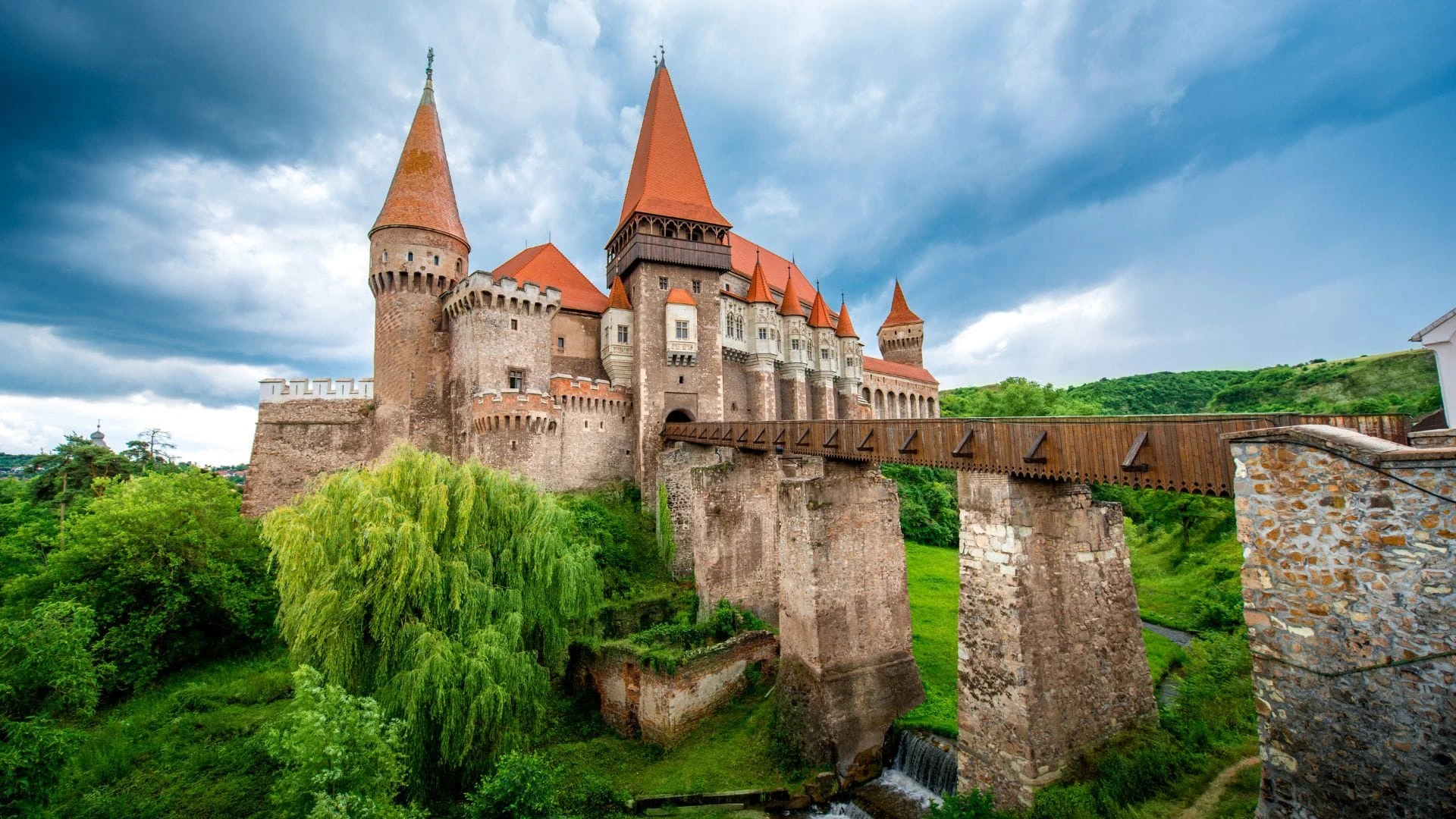
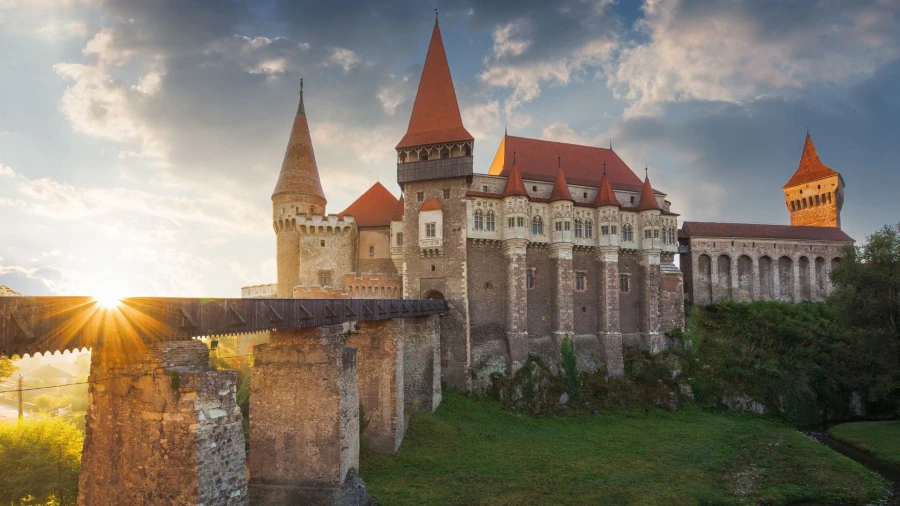
Corvin Castle, also known as Hunyadi Castle, is a historic monument located in the city of Hunedoara, in Hunedoara County, Transylvania.
It is one of the most visited tourist attractions in Romania and part of the national cultural heritage.
Corvin Castle
In this article:
Location and Access
The medieval castle stands in the southwestern part of the city of Hunedoara, built on a rock above the Zlaști River, on the eastern slopes of the Poiana Ruscă Mountains.
By road, you reach the castle via DN 7 (E68), from the east or west, as far as Sântuhalm, and then on DN 68 B into Hunedoara.
Hunedoara
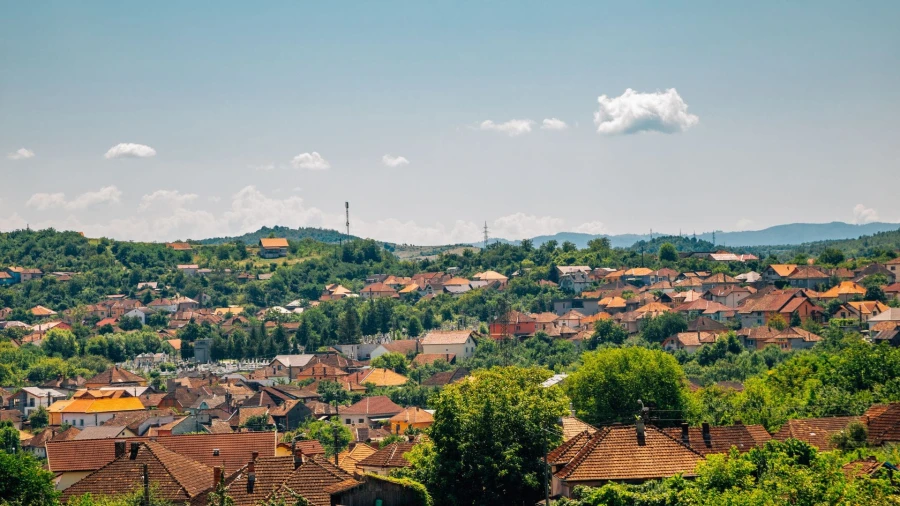
In the city, continue to the City Hall, then along Constantin Bursan Street, from where Hunedoara's castle comes into view.
Deva is about 20 km away and Simeria about 19 km.
The main train station in the area is in Simeria, from where you can take local transportation to Hunedoara. The Hunedoara station closed in 2018.
Near the castle, there is a paid parking lot for cars and buses. It is a few minutes' walk from the main entrance.
For visitors, the pedestrian route to the castle is clearly signposted. You enter through a gate on a wooden bridge suspended over a water channel, a feature that recreates the castle's original defensive function.
In the outer area, there are tourist information points, a souvenir shop, and restrooms.
Brief History
Construction of Corvin Castle began in the first half of the 15th century, on the site of a former fortification, at the initiative of John Hunyadi (Ioan or Iancu de Hunedoara in Romanian, Johannes de Hunyad in Latin), voivode of Transylvania and king of Hungary. The castle was mainly intended as a noble residence and a strategic fortress. See details on Wikipedia
The castle's first documentary mention dates from 1446, when John Hunyadi ordered the building to be extended and strengthened. The initial works included raising the defensive towers, the inner courtyard, and the residential halls. Construction was carried out in several stages, according to the wishes of the owners.
Castle architecture
After John Hunyadi's death, the castle passed to his son, Matthias Corvinus, and was later held by several noble families.
In the 16th–17th centuries, the castle underwent major changes, with new wings, bastions, and fortifications added. During this period, the castle's military role gradually declined in favor of its administrative and residential functions.
Interior
In the 18th century, the castle was partly abandoned and its upkeep neglected. In the 19th century, restoration work began, some of it in the neo-Gothic style, which partly altered the building's original appearance. Work continued into the 20th century, with the aim of stabilizing the structure and making it accessible to the public.
Today, the castle is managed by the local authorities and is open to visitors. Restoration work continues periodically to preserve and promote the historic monument.
The Architecture of Corvin Castle
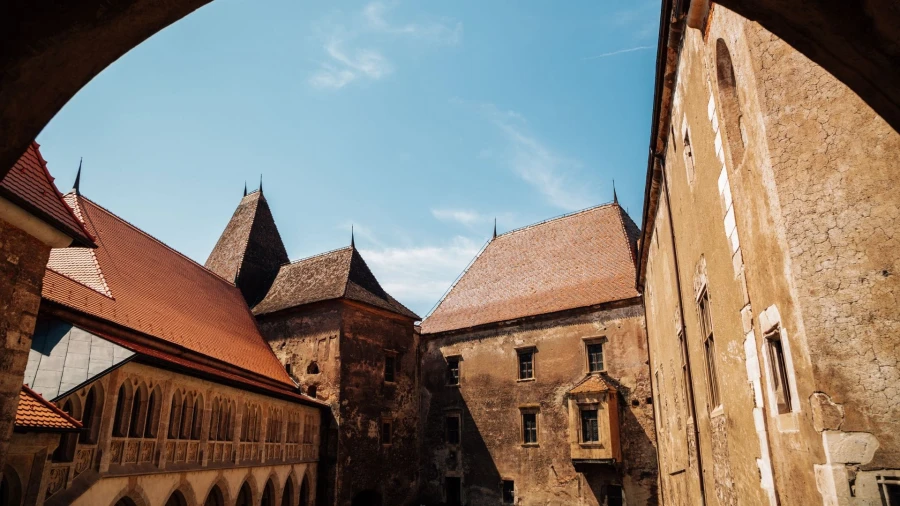
Corvin Castle is an example of medieval military and residential architecture, built mainly in the Gothic style, with Renaissance and neo-Gothic influences added during later restoration phases.
The castle has an irregular plan, adapted to the rocky terrain it sits on. The complex includes several inner courtyards, halls, bastions, and towers, organized into a unified ensemble. The main entrance is via a bridge resting on stone piers that crosses an artificial channel.
Hunyadi Castle
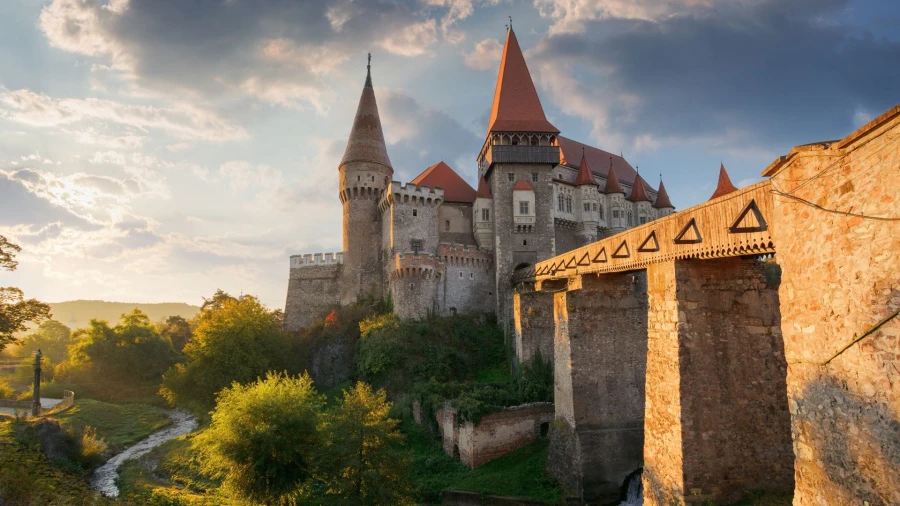
Corvin Castle underwent major transformations under John Hunyadi, starting after 1441. He expanded the old fortress, doubling its enclosure and adding 7 defensive towers (round and rectangular), and completed the works around 1446. Well preserved from this first Gothic phase are the Mace Tower (Painted Tower), the old Gate Tower, and the Capistrano Tower.
Architecture
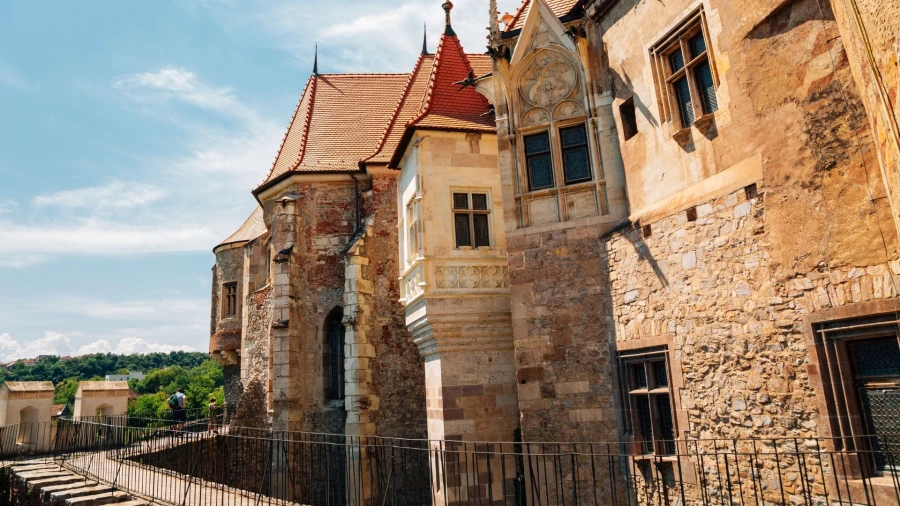
Notable Towers (Phase I):
West Gate Tower: Rectangular, with 3 defensive levels (plus a 19th-century upper floor) and thick walls on the ground floor. It became the main gate in the 17th century, and its first floor was fitted out as the “Ladies' Hall.”
Capistrano Tower: Round (6 m in diameter), with 2 levels (the gunners' room and the Capistrano room with a Gothic fireplace).
Deserted Tower (Lily Tower): Round (6 m in diameter), with 2 defensive levels and machicolations.
Mace Tower (Painted Tower): Tall (30 m), with one defensive level on corbels, notable for its exterior painting with geometric patterns.
A second major construction phase (ca. 1446–1480) added important Late Gothic and Early Renaissance elements:
The Chapel: Completed in 1446, with a nave, a narthex, a gallery with a tribune (bearing the Szilágyi coat of arms), and a sacristy.
The Great Palace: It includes the Knights' Hall (a banquet hall with octagonal columns and an inscription dated 1452) and the Diet Hall (of similar size, with an outer gallery with machicolations and 17th-century paintings). Access is via a spiral staircase with a Renaissance portal (bearing the Corvin family coat of arms).
The Administrative Palace: On the south side, with 3 levels; its current appearance dates from the 17th century.
The Matthias Loggia: One of the earliest examples of the Renaissance in Transylvania, with stacked terraces and a unique secular fresco (15th century) depicting the legend of the Hunyadi coat of arms.
Other Significant Features:
The Neboisa Gallery and Tower: A military innovation (15th century): a long gallery on pillars connected to the castle and a tower with 4 defensive levels.
The Well: 30 m deep and, according to legend, dug by Turkish prisoners. The actual inscription (mid-15th century) is in Arabic and belongs to a slave named Hasan.
Defensive System: It includes a wide, deep outer moat, later doubled by a second moat.
17th century (when the castle was owned by Prince Gabriel Bethlen): additions included the Artillery Terrace and the Hussars' Courtyard (living quarters, stables); the west gate became the main entrance, paintings were added in the Diet Hall, and the statue of St. John of Nepomuk was installed.
The castle is thus an impressive architectural complex that reflects its rich history and diverse functions (residential, military, administrative).
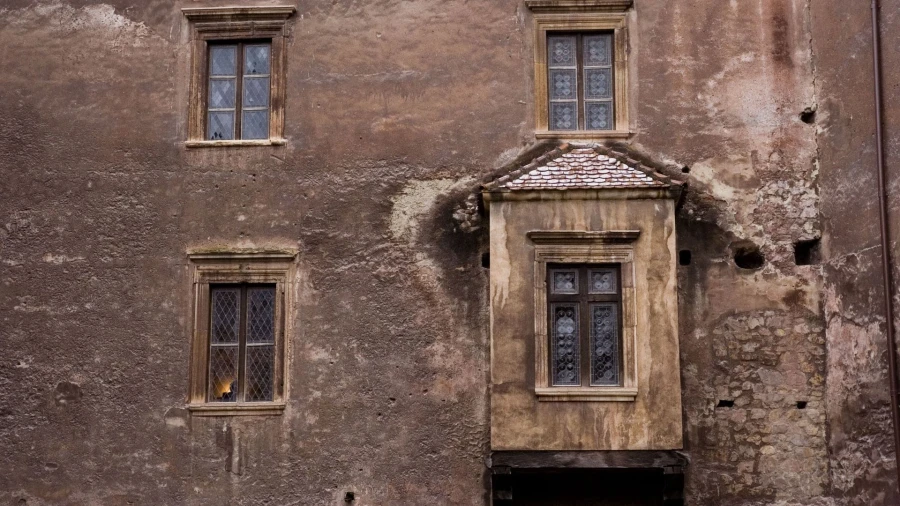
The building materials include stone, wood, and brick. In some areas, the facades were covered with plaster and decorative elements added during the 19th-century restoration.
Inside Corvin Castle
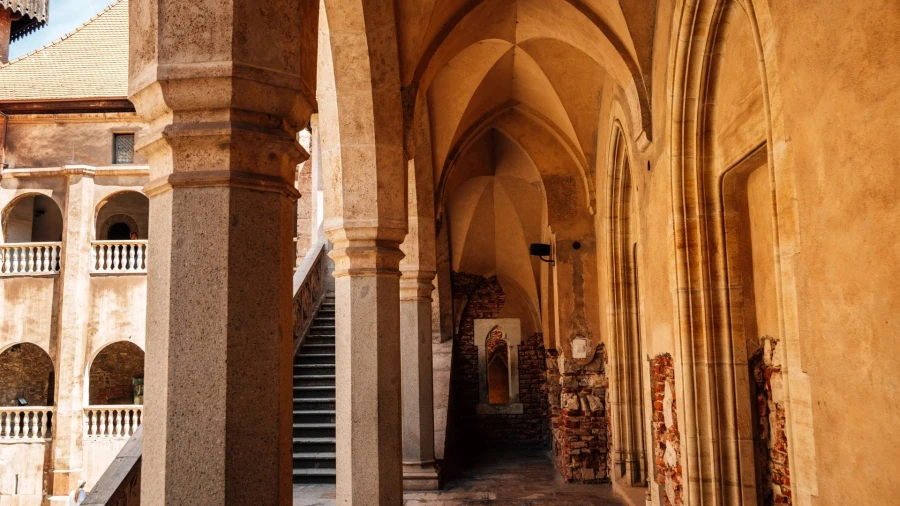
The castle went through several phases of expansion and alteration. It was originally designed as a military fortification but was later adapted to serve as a residence. Modern-era restorations, especially those carried out in the neo-Gothic style, introduced elements that were not part of the original form, but these were kept for visual consistency and for the needs of tourism.
Legends and Mystery
The Corvin family's castle is full of stories, the most famous being:
The Legend of the Raven is tied to the family coat of arms (a raven with a gold ring in its beak). It is said that John Hunyadi, possibly an illegitimate son of King Sigismund of Luxembourg, received a ring as a token of recognition. A raven stole the ring, but young John got it back by shooting the bird with an arrow. Impressed, once the young man reached the royal court, the king decided (or did so later, in recognition of his merits) that the raven would become the family's symbol, hence the name “Corvin” (from Latin corvus = raven).
The Legend of the Well tells of three Turkish prisoners whom John Hunyadi promised freedom if they dug a well. After 15 years of hard work, they found water, but John Hunyadi had died. His wife, Elizabeth Szilágyi, is said to have refused to free them and sentenced them to death. In reproach, the prisoners supposedly inscribed on the well: “You have water, but no heart.” (Historically, the actual inscription is different and mentions the name of a prisoner, Hasan.)
What Visitors Can See
Corvin Castle is open to the public and offers access to a number of historic spaces and areas set up for visitors. The tour route is marked and includes several points of interest both inside and outside the castle.
Corvin Castle – exterior
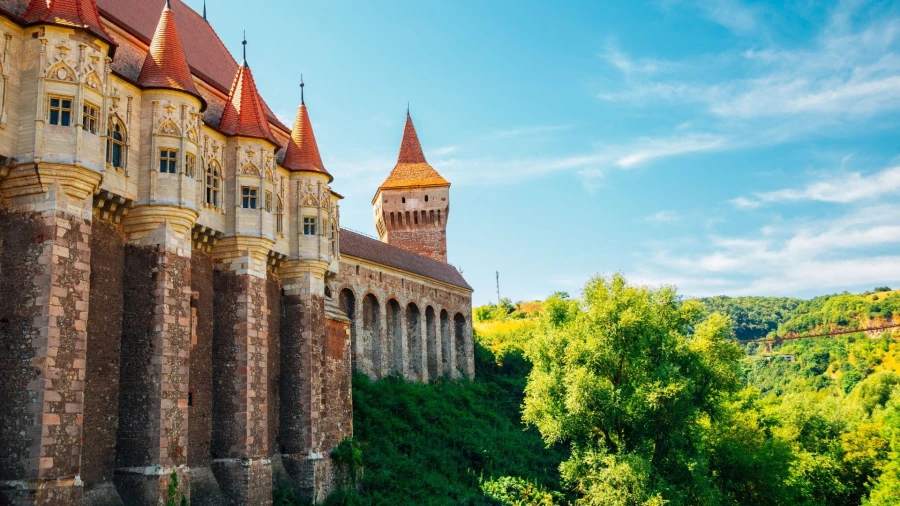
Areas open to the public include:
Inner Courtyard: the central circulation area, bounded by the main walls and the side towers.
Diet Hall: a large room once used for assemblies of the nobility, notable for its Gothic arches and its size.
Knights' Hall: a space used for events and banquets, furnished with period furniture.
Chapel: a small church inside the castle, open to visitors.
Defensive towers: some of them are accessible and offer views of the courtyard and surroundings.
Spiral staircases and corridors: used to move between floors and sections of the castle.
Outer courtyard and defensive walls: here you can see the original defensive structure.
There are also several exhibitions at the castle:
Permanent exhibitions: displays on the castle's history, medieval weapons, archaeological artifacts, historical documents, and reproductions of period costumes.
Temporary exhibitions: held in the side halls or in spaces set up for cultural events. Their themes vary (art, local history, photography).
The optional services include:
Guided tours: available for groups or individuals, in several languages. They require advance booking or can be purchased on site.
Audio guides: available for a fee, in several languages.
Workshops and historical reenactments: held periodically, especially during the tourist season.
Some areas of the castle may be temporarily closed for restoration work or private events.
Access to some walkways or towers may be restricted for safety reasons.
See details here
Opening Hours and Prices
Here are the key details on opening hours and admission prices at Corvin Castle for 2025:
Opening Hours (April 1 – September 30, 2025):
Monday: The castle is open from 12:00 to 20:00.
Tuesday – Sunday: from 09:00 to 20:00.
Important note: Please keep in mind that pets are not allowed inside the museum.
Admission and Service Fees (2025):
The standard ticket includes access to Corvin Castle, the Guild House, and the Archaeology Exhibition.
Adults: 50 lei
School students: 12 lei (currently validated student card required)
University students: 12 lei (currently validated student ID required)
Retirees: 25 lei (recent pension slip required)
Additional Fees:
Photo fee (personal use): 11 lei
Video fee (personal use): 25 lei
Guided Tours:
In Romanian: 55 lei
In a foreign language (English/Hungarian): 90 lei
Professional photo/video shoot fee: 170 lei / hour
Offers for Organized Groups (at least 20 people):
Adults: 40 lei / person
Retirees: 20 lei / person
School/university students: 9 lei / person
Free Admission:
The following categories get in free:
Preschool children (under 7).
Children with disabilities and their companions.
Adults with severe or significant disabilities and their companions.
Representatives of organizations providing free social services (as provided by law).
Important Notes for Visitors:
The castle's distinctive architecture (narrow, steep stairs, elevated passageways) can be difficult or dangerous, especially for children, older people, or those with limited mobility.
Take extra care in elevated areas and do not lean over railings or parapets.
Avoid crowding on stairs, balconies, and suspended galleries.
Keep a constant eye on children throughout your visit.
For more details, you can visit the official website
Corvin Castle – Facilities and Useful Information
Corvin Castle has a number of facilities designed to ensure access and comfort for visitors during their tour.
Access for people with reduced mobility is partly possible on the ground floor and in the outer courtyards.
The narrow stairs and suspended walkways are not suitable for wheelchairs or people with walking difficulties.
There are no elevators or special platforms inside the castle.
Tours can be arranged for school groups, tour groups, or themed groups.
Booking in advance is recommended, especially during the tourist season.
Group discounts are available, depending on the size and type of group.
Café / snack bar: open seasonally near the castle.
Rest areas: benches and seating in the outer courtyards.
Information points: explanatory panels in Romanian and English in the main areas.
Public Wi-Fi: available only in the entrance area and the administrative spaces.
Photography is allowed for personal use for a small fee.
Professional or commercial filming requires prior approval from the administration.
On average, the tour route takes about 1.5–2 hours. Visitors who join guided tours or stop at the exhibitions may want to set aside 2 to 3 hours.
Peak season at Corvin Castle runs from May to September, when opening hours are extended. To avoid the crowds, weekday morning visits are recommended. In the off-season, there are fewer visitors, but some facilities may operate on a limited basis.
Hunyadi Castle has also been the filming location for many movies: “Ghost Rider: Spirit of Vengeance” (2011), “The Nun” (2018), “Singur împotriva rețelei” (2009), “Dragonheart: Battle for the Heartfire” (2017), “Vlad Țepeș” (1979), and “Nunta mută” (2008).
Accommodation
In Hunedoara, you'll find various accommodation options to suit your visit.
Hotel Bulevard, centrally located, offers easy access to the city's amenities and has a restaurant and bar.
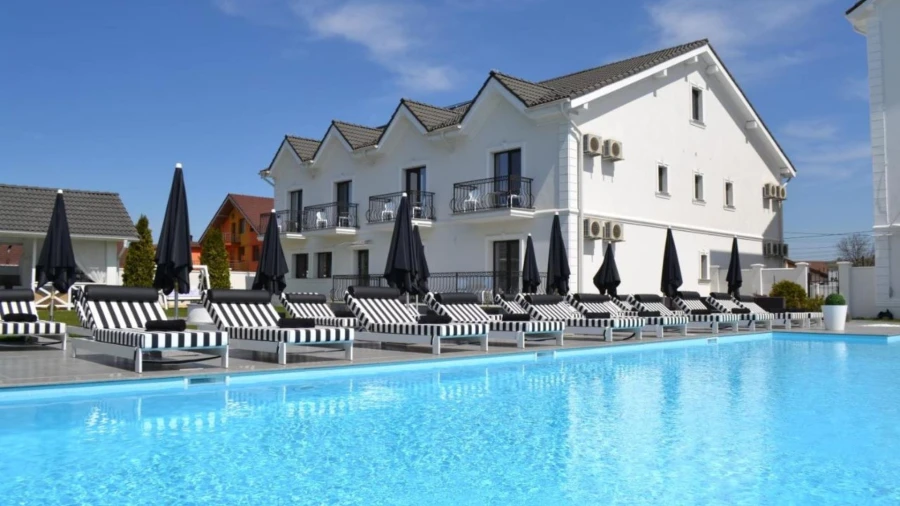
For those who prefer modern design and a location close to the castle, Kristal Boutique Mansion is a popular choice and also offers free parking.
Crystal Boutique Mansion
You can also choose Pensiunea Curtea Veche, just a few minutes' walk from the castle, a guesthouse known for its cleanliness and welcoming atmosphere, with a garden and parking.
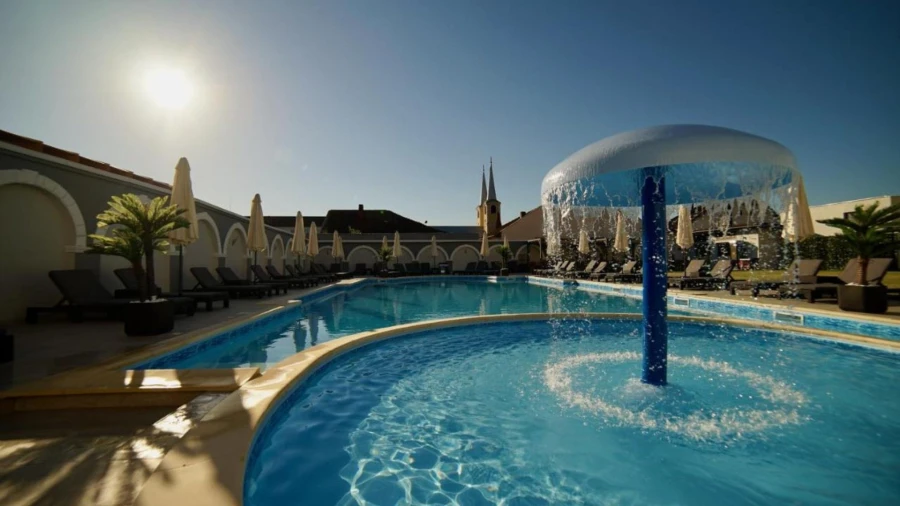
If relaxation is a priority, Hotel Astoria and Spa stands out for its fully equipped spa, along with a restaurant and comfortable rooms.
Hotel Astoria&Spa
For more independence, Best Studio offers a modern studio apartment with its own kitchenette.
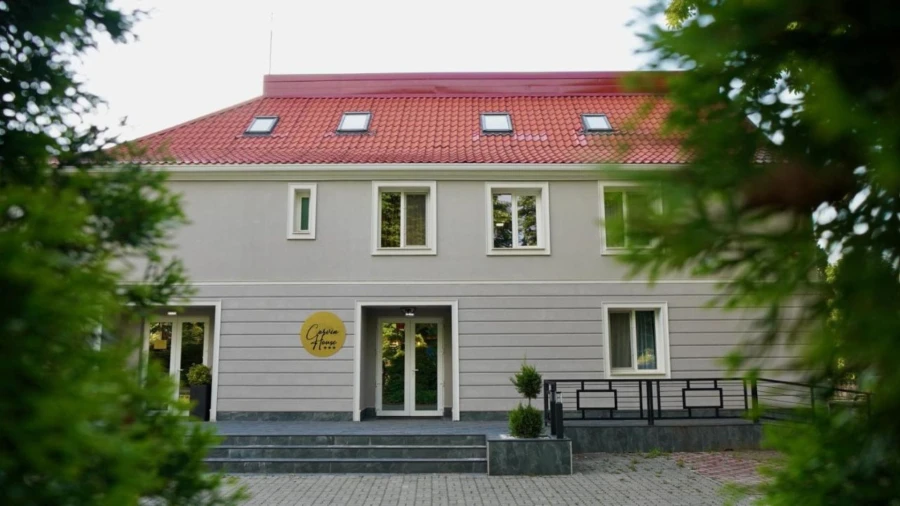
Corvin House, a guesthouse very close to Corvin Castle, offers comfortable rooms, some even with views of the monument, and is valued for its proximity to the castle.
Corvin House
Nearby Attractions
Near Corvin Castle, visitors can discover other attractions and points of interest in Hunedoara County. These can be included in a wider itinerary through the region.
Deva Fortress
This medieval fortification stands on Citadel Hill (Dealul Cetății) in Deva, about 20 km from Corvin Castle. See details
Alba Carolina Citadel
Alba Carolina Citadel is a Vauban-style fortification in Alba Iulia, about 70 kilometers from Corvin Castle. The citadel area is set up for visitors and includes museums, churches, and pedestrian routes open to tourists. See more in the article.
Museum of Dacian and Roman Civilization – Deva
This county museum is housed in the Magna Curia Palace, also known as Bethlen Castle, with exhibitions on the history of Dacia, the Roman period, and local civilization. See details
Sarmizegetusa Regia
The archaeological site is about 50 km away and was the capital of the Dacian kingdom. It lies in the Orăștie Mountains and is a UNESCO World Heritage Site. See details on Wikipedia
Prislop Monastery
About 25 km away lies an important Orthodox monastery in the county, known for its connection to Father Arsenie Boca.
Hațeg–Slivuț Bison Reserve
The reserve is 90 km from Corvin Castle and 3 km from Hațeg. It is a protected area where you can see European bison living in semi-free conditions. See details
Hațeg Country Dinosaur Geopark
An area of internationally recognized geological and paleontological value, a UNESCO site, with visitor centers in several villages. Find out more here
Kendeffy Castle – Sântămăria-Orlea
Located about 30 km from the castle, it was an 18th-century noble residence belonging to the family of the same name.
See more details here
Weather in Hunedoara
In Hunedoara, summers are generally warm and pleasant, while winters bring low temperatures and the possibility of snow. In spring and fall, the weather is more changeable, with variations in temperature and precipitation.
To plan your visit properly, it's always a good idea to check the latest weather forecast. Here is the weather for the next 7 days in Hunedoara:
Conclusion
Corvin Castle is one of Romania's major tourist and historical attractions, drawing thousands of visitors from around the world every year.
It is a remarkable example of Gothic architecture, with influences from later periods, and reflects both its defensive functions and its role as a residence.
From fortresses and history museums to places of worship and natural attractions, Hunedoara County offers plenty of options for those who want to learn more about the past and landscapes of this area.
In conclusion, Corvin Castle is not only a symbol of Romania's cultural heritage but also a place that actively contributes to the development of tourism in the region, offering visitors an authentic journey into the medieval history and architecture of Transylvania.
Also read our articles about other famous castles in Romania, Bran Castle and Cantacuzino Castle.