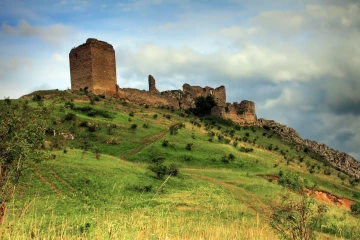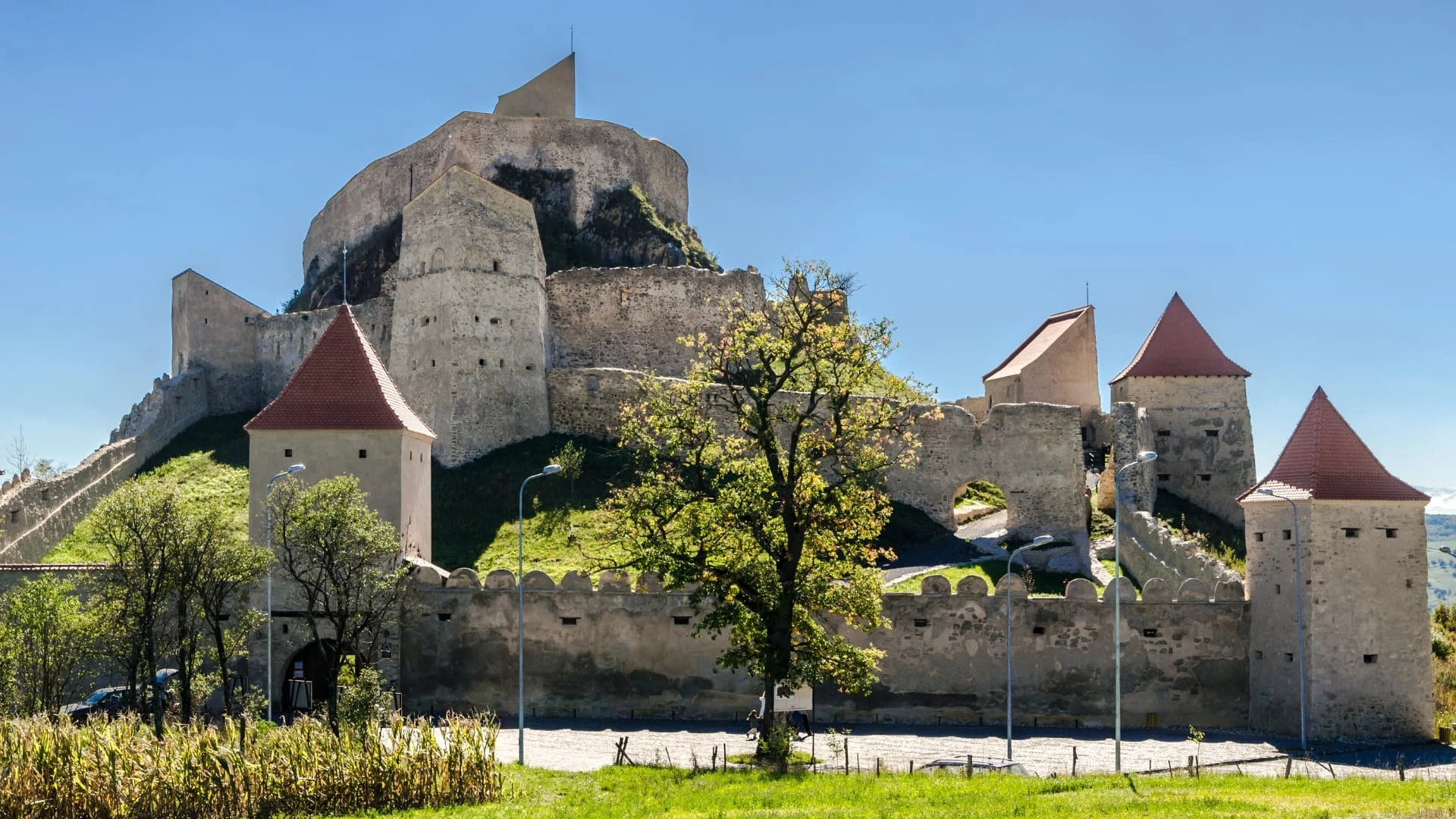
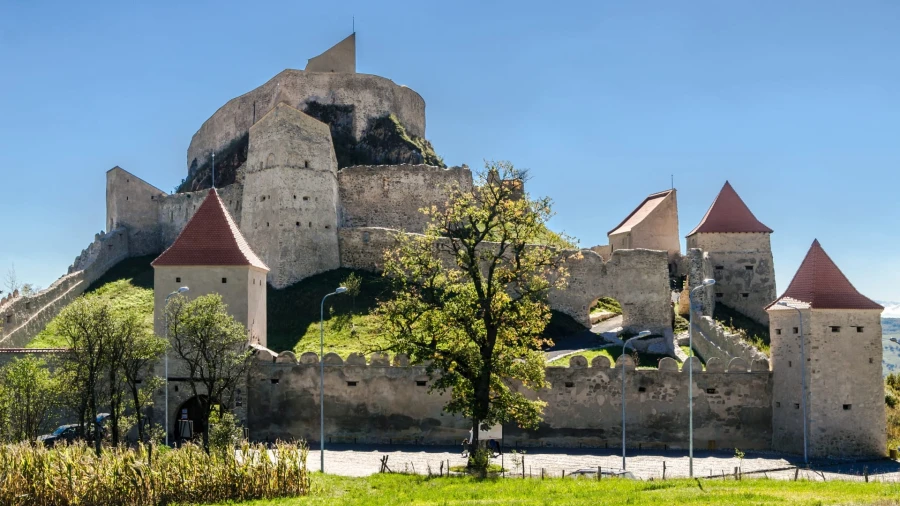
Rupea Fortress is one of the oldest and most impressive medieval fortifications in Romania, strategically located on a rocky hill in the west of the town of the same name, in Brașov County.
Rupea Fortress
In this article:
Rupes means rock cone in Latin and refers to the basalt rock on which the fortress stands. It was also called Cohalm Fortress (Castrum Kuholm), after the name of the hill, Cohalm Hill.
Location and Access
The fortress dominates the skyline of the town of Rupea and is visible from a considerable distance thanks to its location on National Road DN13, European route E60, which links Brașov with Sighișoara and Târgu Mureș.
Access
From Brașov, take the DN13/E60 toward Sighișoara; the road is well signposted.
From Târgu Mureș, follow the same DN13/E60 south, toward Sighișoara and Brașov. The fortress has a parking lot at the foot of the fortifications (100 spaces for cars and 10 for coaches).
Coaches and buses running on the Brașov–Sighișoara route stop in the town of Rupea. From there, the fortress is an easy walk away.
Landscape in Rupea
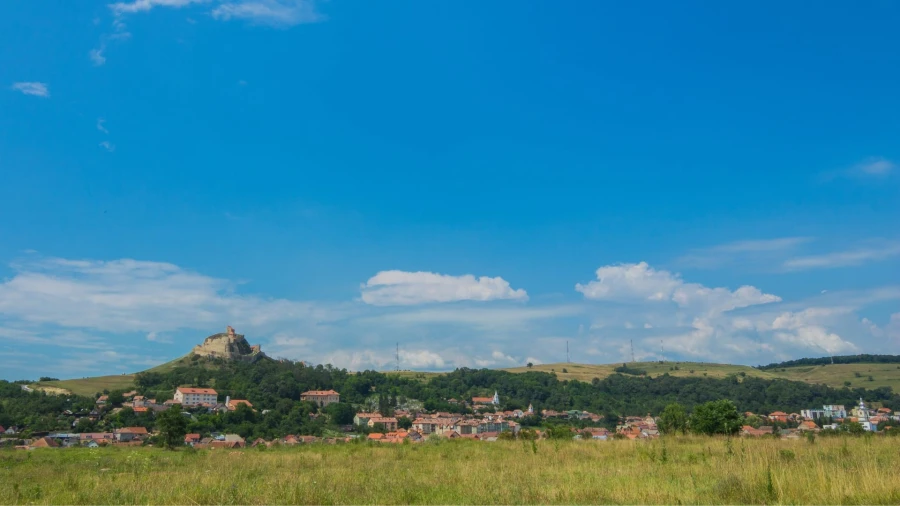
Rupea is about 65 km from Brașov, but it is also easy to reach from other towns:
from Făgăraș: 52 min (51.2 km) via DN1S and DN1/E68
from Sighișoara: 47 min (51.4 km) via DN13/E60
from Sibiu: 2 hr 3 min (131.6 km) via DN1/E68
from Mediaș: 1 hr 23 min (90.1 km) via DN13/E60 and DN14
from Praid: 1 hr 37 min (100.4 km) via DN13/E60, DN13C, and DN13A
from Târgu Mureș: 1 hr 45 min (104.8 km) via DN13/E60
from Sfântu Gheorghe: 1 hr 14 min (68.7 km) via DN13/E60 and DN13E
from Odorheiu Secuiesc: 59 min (49.0 km) via DJ132B and DJ131
from Viscri: 22 min (15.8 km) via DJ105A and DJ104L
from Râșnov Fortress: 1 hr 19 min (79.9 km) via DN13/E60
from Feldioara Fortress: 49 min (47.8 km) via DN13/E60
History of Rupea Fortress
The origins of Rupea Fortress are linked to a Dacian fortification called Ramidava or Rumidava (ancient archaeological remains), which stood here before the Roman occupation of Dacia. Legend has it that Decebalus took his own life here.
After the Roman conquest, it became the Roman fort of Rupes.
After the Romans withdrew, the fortress was probably abandoned for a time, but its strategic position ensured that it was rebuilt and expanded in the following centuries.
The first documentary mention of the fortress dates from the 14th century, in 1324, when the Saxons took refuge in the fortress from King Charles Robert of Hungary.
In the 15th century, the fortress was an important center of trade and crafts, with 12 guilds.
Over the centuries, the fortress played a crucial role in defending the region against foreign invasions and in protecting its inhabitants from internal conflicts.
It was a key point in the network of fortifications that defended Transylvania's medieval borders. See Alba Iulia Citadel.
Thanks to its position on the trade routes that crossed the region, the fortress also played a significant economic role, serving as a center for trading and storing goods.
Over time, the fortification was expanded and strengthened in several stages.
In the Middle Ages, Rupea Fortress played an essential role in Transylvania's defensive system, when it was attacked by the Tatars and the Ottomans.
Michael the Brave laid siege to the fortress on his way to Șelimbăr.
In the 16th century, the fortress was further fortified to withstand sieges, with new towers and bastions added.
In the modern era, once the threat of invasion had faded, the fortress gradually lost its military importance.
By 1643, the fortress lay in ruins after a devastating fire, and in the first part of the 18th century its walls served as a refuge for survivors of the plague epidemic.
The fortress was completely abandoned in 1790, after a violent storm destroyed its roof. Local communities used stones from the fortress to build houses, contributing to its deterioration.
The town of Rupea, however, was transformed in the interwar period, becoming an important cultural center for the Saxons.
Rupea Fortress was recognized for its historical and architectural value in the 1950s, when the first restoration attempts began. Restoration work remained sporadic and insufficient until the 2000s, when projects backed by EU funds made it possible to restore a large part of the fortress. See Wikipedia.ro
In 2013, Rupea Fortress was fully restored and reopened to the public, becoming a major tourist attraction.
Today, Rupea Fortress draws thousands of visitors every year, who come to explore the stronghold and discover its history.
Architecture of Rupea Fortress
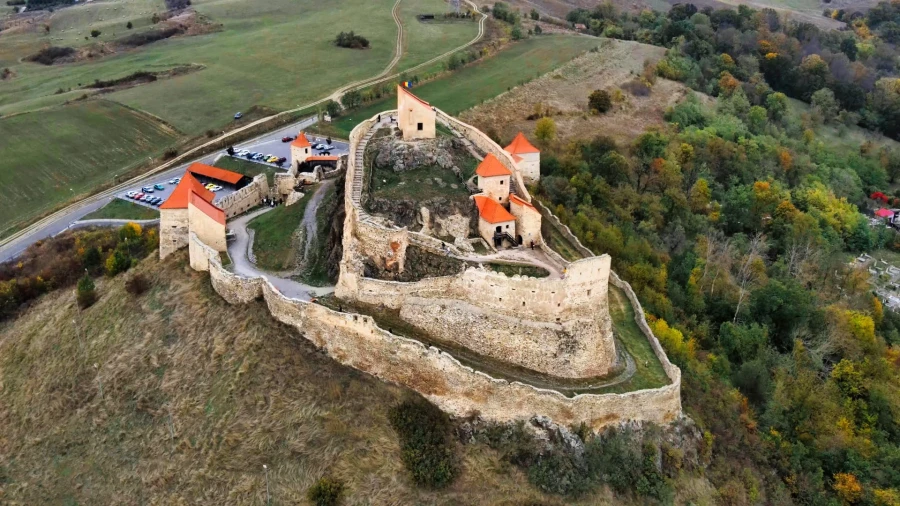
Rupea is an impressive example of fortified medieval architecture, spread over 11 ha in the shape of an ascending spiral, adapted to the hilly terrain on which it is built.
Rupea Fortress seen from above
Structure and Sections of the Fortress
The fortress is organized into three distinct enclosures, known as the Lower Fortress, the Middle Fortress, and the Upper Fortress, each with its own specific functions and defensive roles:
The Lower Fortress
Rupea Fortress ruins
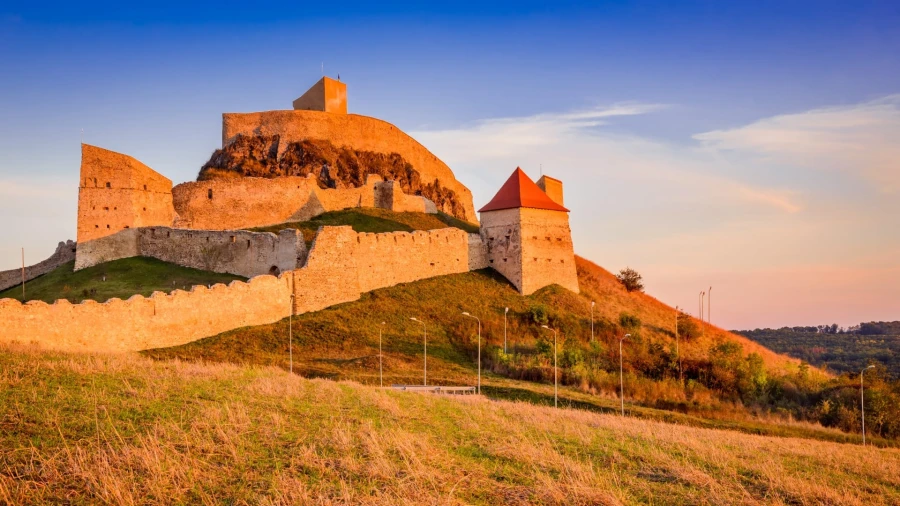
It is the largest of the three sections and the most recent, having been extended in the 17th-18th centuries. It sheltered the local community in case of attack and had numerous buildings for storage, stables, and temporary housing.
Here you'll find the fortress keeper's house, built in 1850, and the military storehouse (early 19th century).
The walls of this enclosure are less massive than those of the other two, but they were enough to provide protection against light attacks.
The Middle Fortress
Rupea Fortress walls
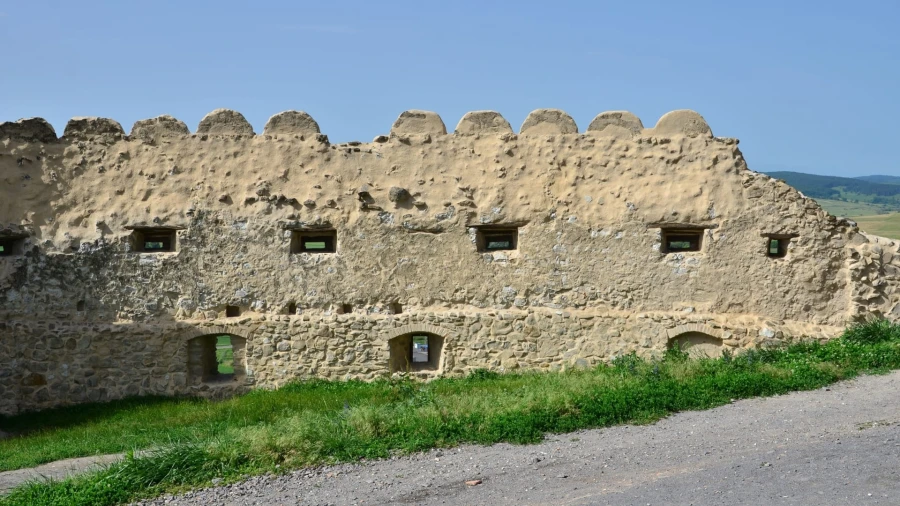
This section is older than the Lower Fortress and represents the fortified core that evolved during the early Middle Ages.
It protected stores of food, weapons, and other essential goods during sieges. The walls here are thicker and higher, with towers and loopholes to defend against direct attacks. It also included permanent quarters for the fortress garrison.
The Upper Fortress
Rupea Fortress landscape
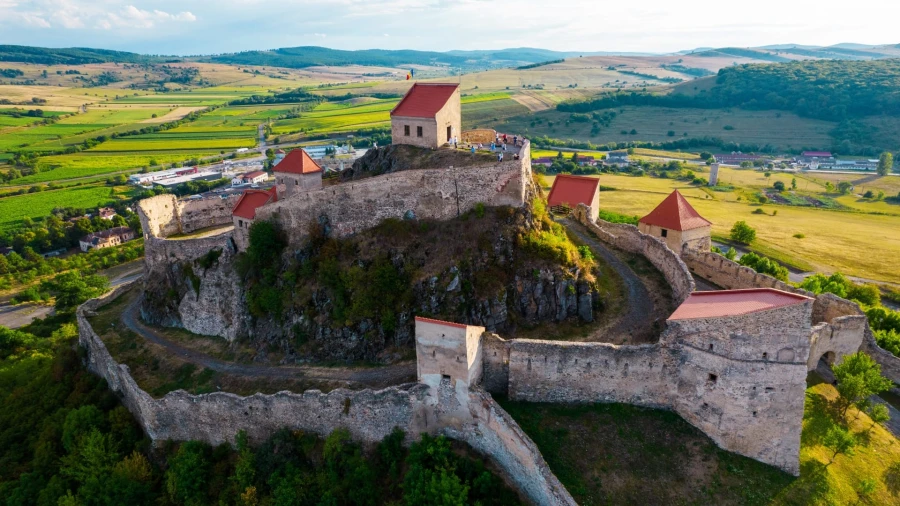
Located at the highest point of the hill, the Upper Fortress is the oldest and best-fortified part of the complex.
It was the defensive heart of the fortress, housing the most important administrative buildings, such as the fortress commander's house, as well as the 59-meter-deep well, essential for survival during prolonged sieges.
Architectural Elements
The fortification reflects the influences of Transylvanian medieval architecture, combining solid defensive features with aesthetic details specific to different historical periods.
The Fortified Walls
Inside Rupea Fortress
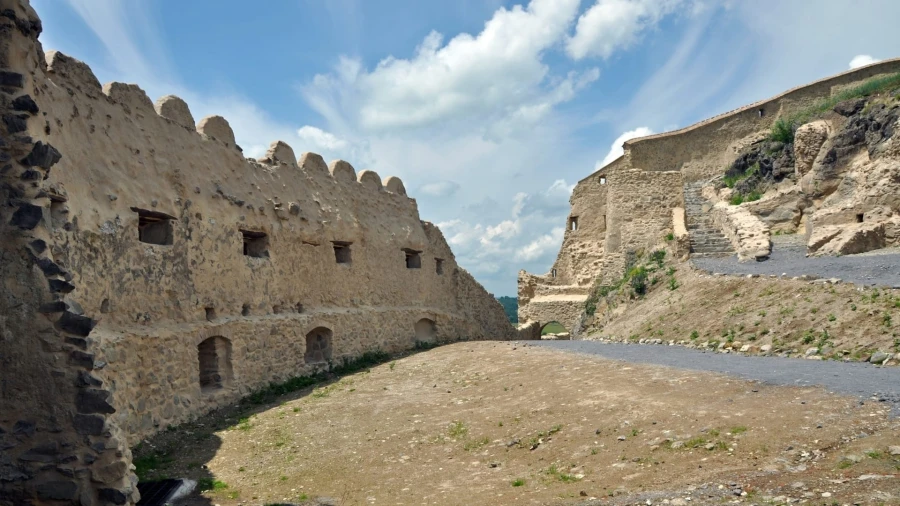
The walls are built of local stone, laid in uneven courses, which gives them a sturdy, massive look. Their height and thickness vary by section, with the walls of the Upper and Middle Fortresses being significantly sturdier.
Ruins inside Rupea Fortress
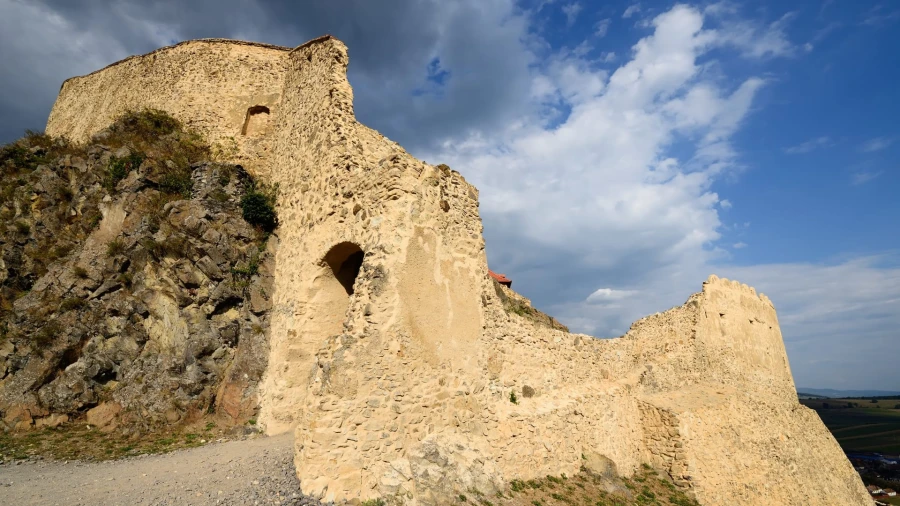
They are fitted with watchtowers and bastions, which allowed soldiers to keep watch and defend against any attack.
Towers and Bastions
Photo from Rupea Fortress
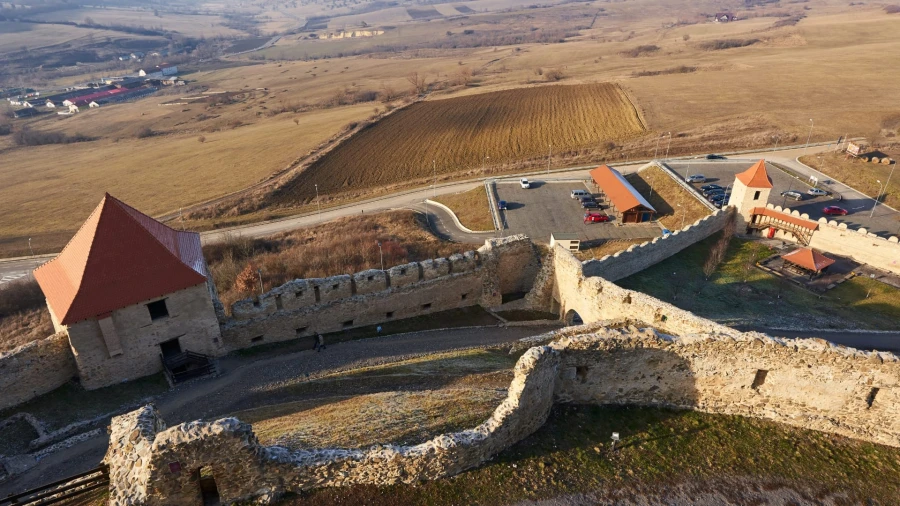
Rupea Fortress has several defensive towers (the Gate Tower, the Fortress Tower, the Servants' Tower), each with specific functions.
The Bacon Tower (formerly called the New Tower), typical of the Saxon community, is one of the best known and was used for storing and drying bacon and other foods.
In the Middle Fortress, you'll find the Ungra Tower (with important archaeological finds), the Pentagonal Tower, and the Clerks' Tower, which probably held the archives of the Saxon seat.
On the western curtain wall, the towers are easier to identify, including the Scouts' Tower, the Chapel Tower, and two other, less well-preserved towers flanking the access corridor: the Thick Tower and the Powder Tower (located near the entrance to the Upper Fortress).
The Pentagonal Tower, the most impressive of them all, is representative of Transylvanian military architecture from the second half of the 16th century, influenced by Italian master builders of the late Renaissance.
The towers were built to offer a panoramic view of the surroundings, while the bastions allowed defenders to fire crossbows or firearms at the enemy.
The Fortified Gates
Rupea Fortress – interior access area
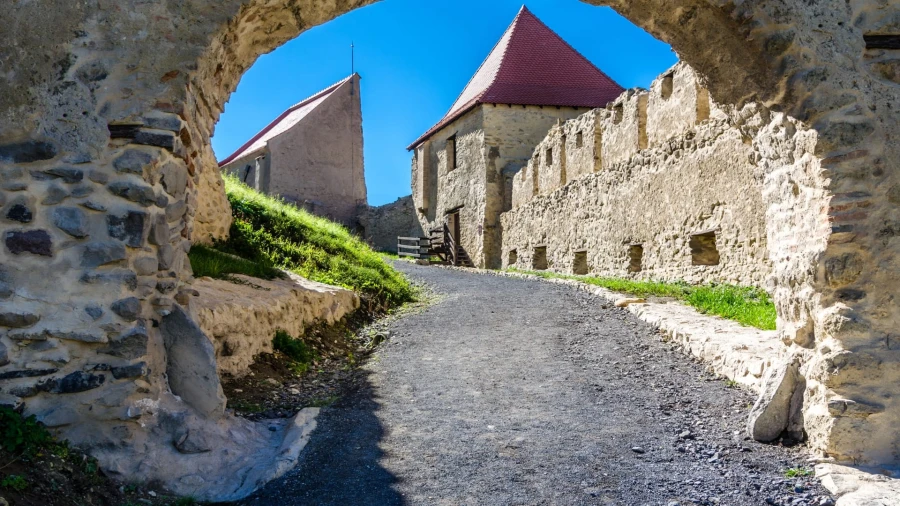
Access to the fortress was through several fortified gates, each protected by towers and narrow passageways designed to slow the enemy's advance.
The main entrance gate, located at the base of the Lower Fortress, was defended by a massive tower and equipped with a drawbridge that could be raised in case of danger. See more details here
The Fortress Well
Rupea Fortress – Inner Courtyard
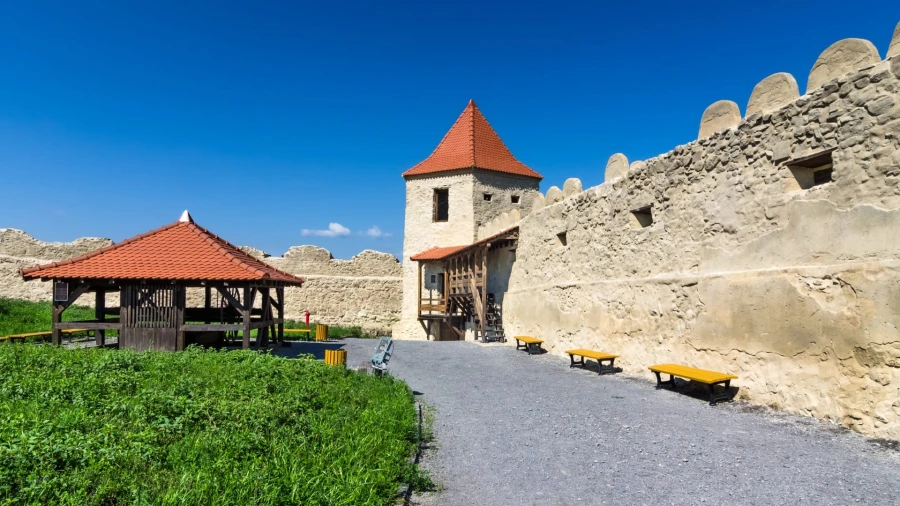
An architectural feature essential to the fortress's survival during sieges is the 59-meter-deep well in the Upper Fortress. It provided a steady supply of water for the fortress's inhabitants, a crucial factor in a place that could be isolated and closed off for long periods.
The Interior Buildings
Rupea Fortress – access stairs
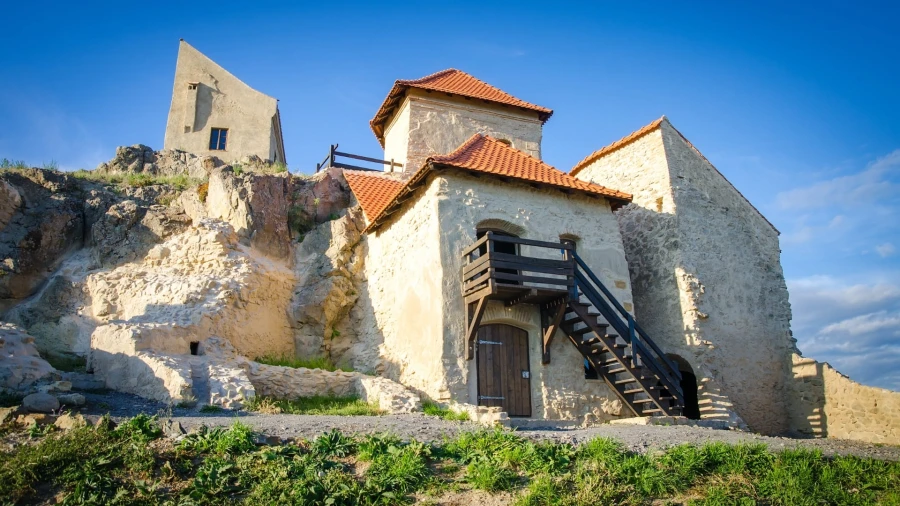
The fortress housed various interior buildings, most of them made of stone and wood, which served as temporary housing, supply stores, and stables for animals. The buildings were simple and functional, built to last and to provide protection.
Materials and Construction Techniques
Rupea Fortress was built from locally available materials, especially stone, which gives it remarkable strength and a solid appearance.
Wood was used for auxiliary structures, gates, and roofs.
The walls were built using medieval masonry techniques, with stone blocks of different sizes bound with lime mortar. In the older parts of the fortress, you can see traces of rubble-stone construction, typical of the early Middle Ages.
Rupea Fortress tower
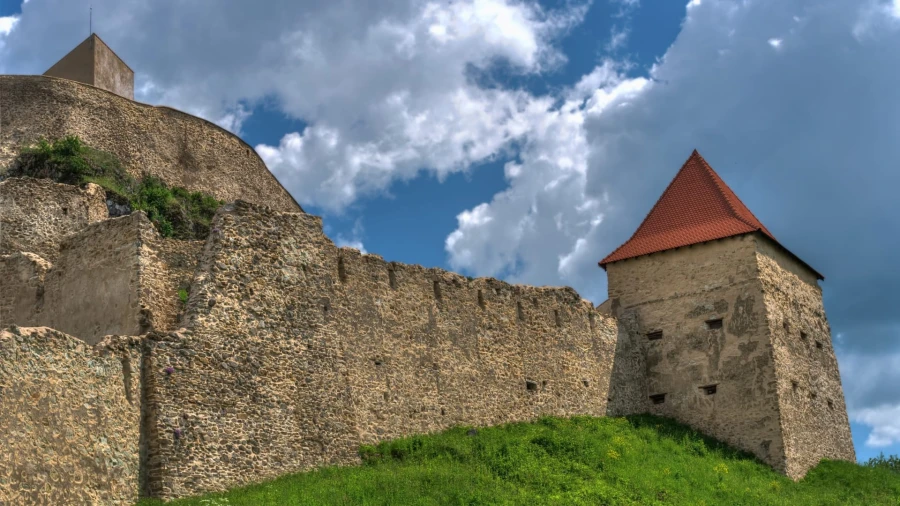
The fortress's architecture reflects the evolution of building techniques and the defensive needs of the time, adapting to new military technologies and to the need to protect the local community.
Strategic Role
Rupea Fortress had a particularly important strategic role thanks to its location on a rocky hill offering excellent visibility over the surrounding roads and lands.
Its position allowed it to oversee and protect trade routes and to defend the territory against foreign invasions.
Its massive walls and watchtowers enabled the garrison to repel assaults and protect the local population. During attacks, locals took refuge in the fortress, which could withstand a prolonged siege thanks to its provisions and the deep well in the Upper Fortress. That is why it was considered a town in miniature.
Besides its defensive function, Rupea Fortress also had an important economic and administrative role. As a checkpoint on the trade routes, the fortress facilitated trade and collected taxes from merchants.
It also served as a center of local administration, where disputes were settled and community affairs were managed.
Rupea Fortress Today
Since its restoration in 2013, Rupea Fortress has become one of the most important tourist attractions in Transylvania and in Romania.
Access to Rupea Fortress
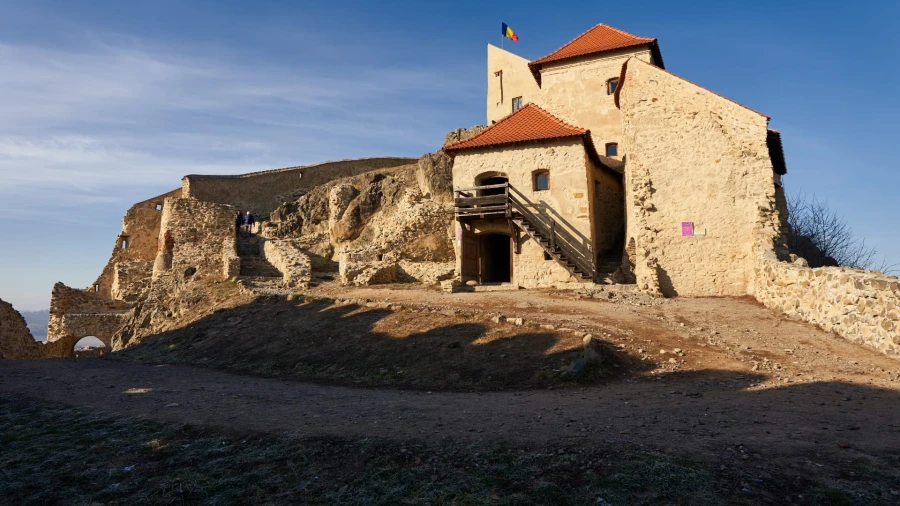
Every year, thousands of tourists visit the fortress, which is a destination not only for history buffs but also for those looking to experience the rural authenticity of Transylvania.
Access to the fortress is well signposted, and there is a large parking lot at the foot of the hill. Inside the fortress, paved paths, safety railings, and viewpoints have also been set up, allowing visitors to admire the impressive views of the surroundings.
The architectural lighting of the fortress is another highlight, turning the stronghold into a visual spectacle after nightfall and offering an unforgettable sight to anyone passing through the area.
The fortress hosts permanent and temporary exhibitions in various restored rooms, featuring historical artifacts, medieval costumes, and detailed information about the history of the site.
Medieval festivals, concerts, historical reenactments, and art exhibitions draw both locals and visitors from all over the world. These events help promote the cultural heritage and involve the local community in preserving and showcasing the fortress.
The revitalization of Rupea Fortress has had a significant impact on the local economy. Locals have opened guesthouses, souvenir shops, and other businesses that cater to tourists, contributing to the economic development of the area.
There are plans to expand the tourist facilities, such as introducing audio and visual guides, developing an interactive museum within the fortress, and creating themed trails around the fortress that connect visitors with other points of interest in the area.
Opening Hours and Prices
Fortress opening hours:
November 1 – March 31: 9:00 – 17:00
April 1 – August 31: 9:00 – 20:00
September 1 – October 31: 9:00 – 19:00
Prices:
Adults: 15 lei / person
Adults with audio guide: 20 lei / person
Children under 18: 8 lei / person
Group rates:
Groups of at least 20 adults: 12 lei / person
Groups of at least 20 children: 5 lei / person
Nearby Attractions
In the town of Rupea and around the fortress, there are several interesting sights worth visiting:
Fortified Evangelical Church in Rupea
Located right in the town of Rupea, the Gothic church is an important example of Saxon fortified architecture. With its long history and distinctive architectural style, the church is one of the most visited attractions in town.
The Mud Volcanoes of Băile Homorod
About 10 km from Rupea, this rare natural phenomenon, the Homorod mud volcanoes, offers a fascinating sight for nature and geology lovers.
Viscri Village
About 25 km from Rupea, the village of Viscri is famous for its fortified church, a UNESCO World Heritage Site. This traditional Saxon village has become known for its efforts to preserve its authentic heritage and for the presence of King Charles.
Dopca Gorges Nature Reserve
The nature reserve is about 20 km from Rupea and offers scenic hiking trails through spectacular gorges, making it an ideal place for nature and adventure lovers.
Sighișoara Citadel
Sighișoara Citadel
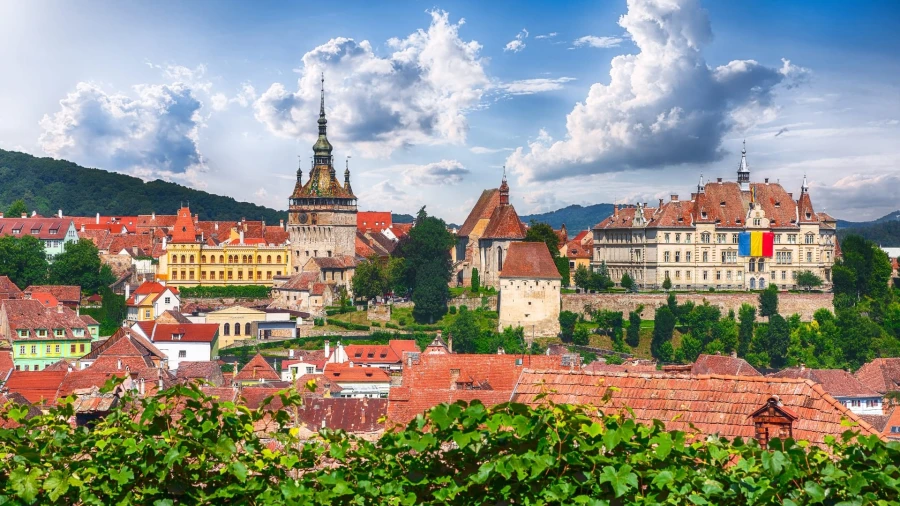
About 50 km from Rupea, Sighișoara, another medieval town on the UNESCO World Heritage list, is a major tourist attraction in Transylvania, known for its medieval citadel and historic towers.
Farther afield, you can visit the Doftana Valley (140 km away), the Praid Salt Mine (100 km away), and the Bicaz Gorges (about 150 km away).
In the Brașov area, you can also visit Râșnov Fortress, Bran Castle, and the Black Church.
Accommodation and Facilities in Rupea
The growing number of tourists has led to the development of accommodation, restaurants, and other tourist facilities in the town of Rupea and the surrounding villages. See booking.com.
The town of Rupea and the surrounding areas (within a 10-20 km radius) offer accommodation options for tourists, from guesthouses and traditional houses to hotels (Michael's House Guesthouse, Hotel Dumbrava, Viscri 32 – White Barn and Blue House, Viscri 125), to suit different needs and budgets.
The town offers various facilities for tourists, including restaurants (Motel Restaurant Liliana) serving traditional and international dishes, cafés, shops and local markets, banks and ATMs, and tour guides for exploring the fortress and nearby attractions.
There are also camping options for those who prefer to experience nature up close.
Weather
Current weather in Rupea and the forecast for the next 7 days:
Frequently Asked Questions
What are the opening hours of Rupea Fortress?
Currently, from September 1 to October 31, the fortress is open from 9:00 to 19:00.
Where is Rupea Fortress located?
Rupea Fortress is located in the town of Rupea, in Brașov County. It can be seen from the DN13/E60.
Conclusion
Landscape with the walls of Rupea Fortress
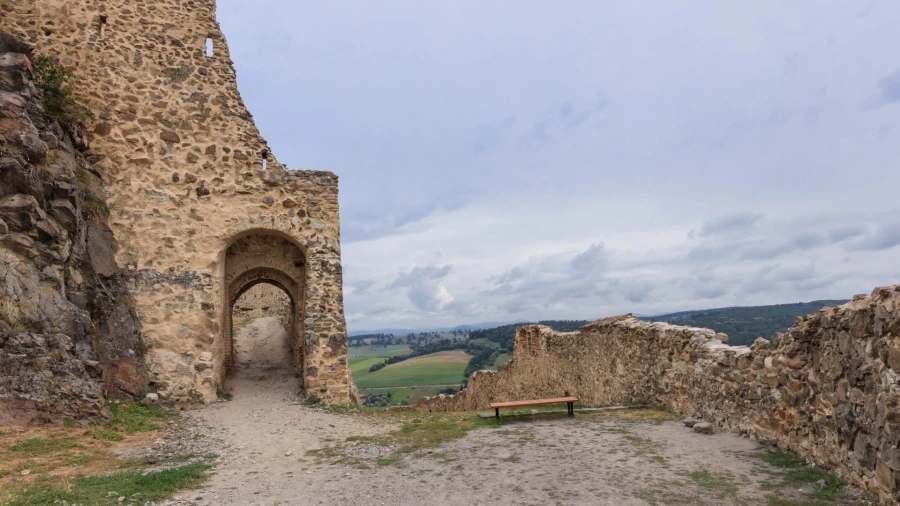
Rupea Fortress is a true gem of Romania's historical and cultural heritage.
From its strategic role in the medieval history of Transylvania to its transformation into a top-tier tourist attraction, the fortress has evolved significantly, becoming a symbol of regional identity and local cultural traditions.
Rupea Fortress remains a living example of Transylvania's medieval heritage, attracting visitors from all over the world.
We also invite you to explore Alba Iulia Citadel, Colțești Fortress, and Deva Fortress.
About 100 km away is Sovata Resort, one of the most popular resorts in Romania.