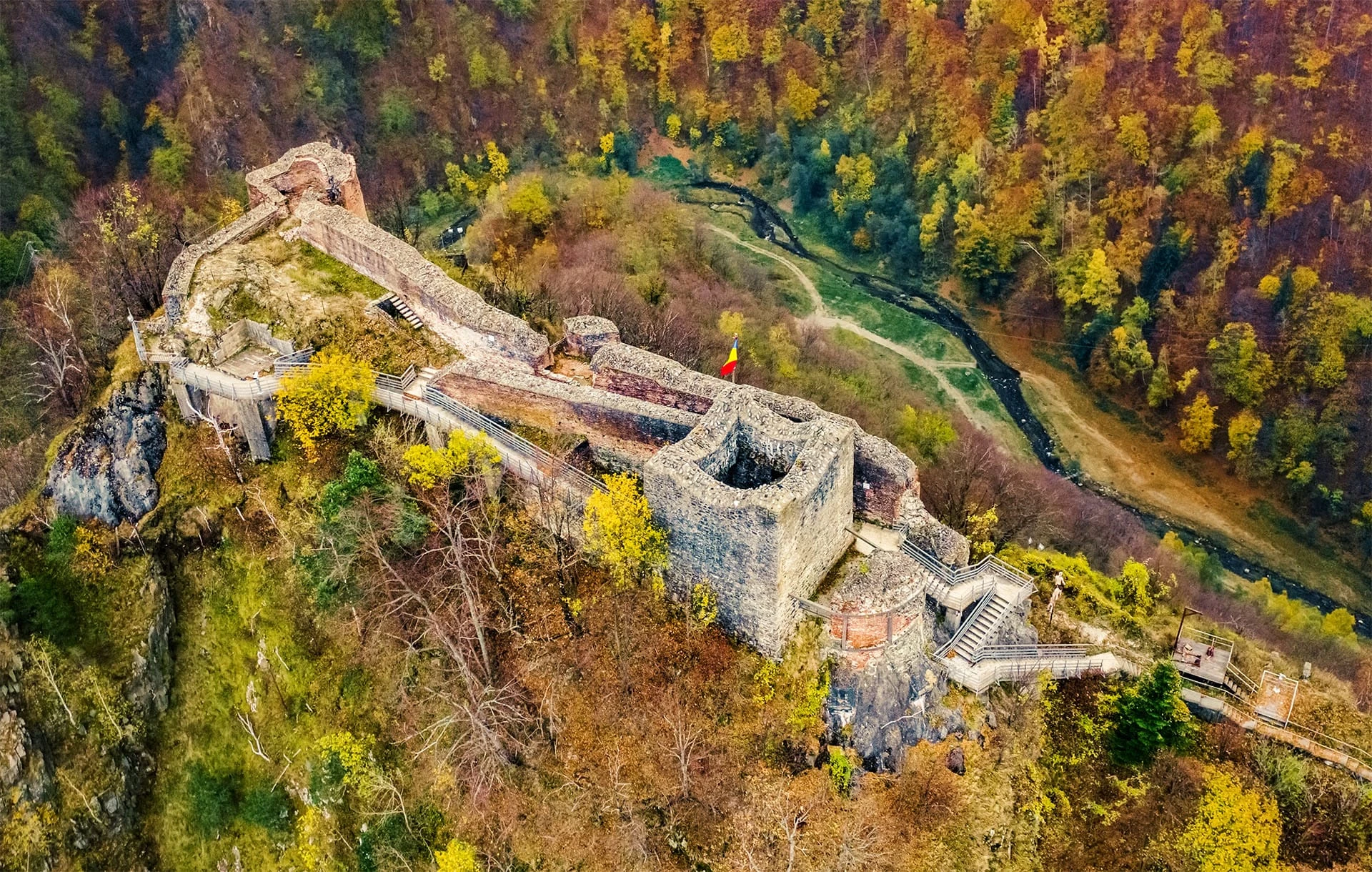
Poenari Fortress is an important historical monument of Romania, closely linked to the legendary ruler of Wallachia, Vlad the Impaler, son of Vlad Dracul.
It is also called Vlad the Impaler's Fortress or Negru Vodă's Fortress.
Poenari Fortress landscape
In this article:
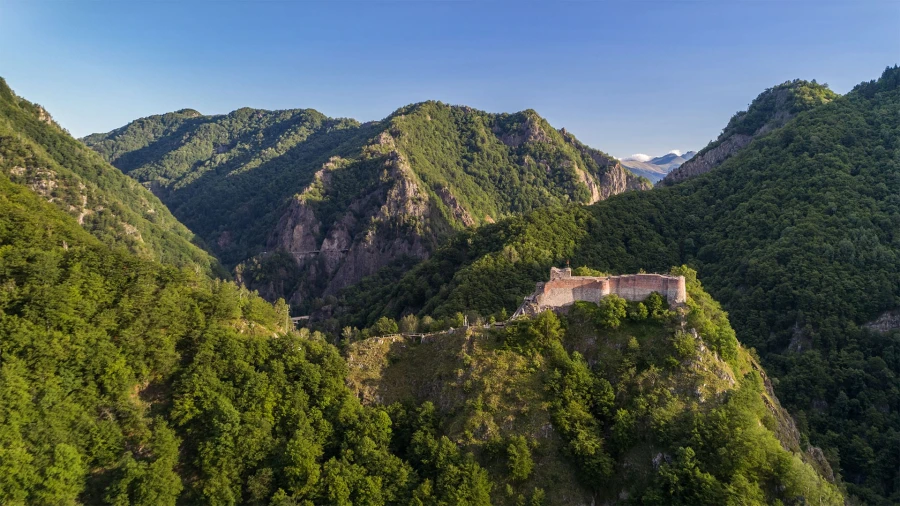
Strategically perched on a rocky peak in the Făgăraș Mountains, 400 meters above the Argeș Valley, the fortress offers spectacular panoramic views all around.
Its existence is tied to military purposes: it served as a defensive point and refuge, a place to keep the treasury, and even a prison. But it is valued not only for its historical significance, but also for its impressive location.
Access, location, and distances
The fortress is strategically located on the Transfăgărășan road, about 4 km from Lake Vidraru and Vidraru Dam, in Argeș County.
To get to Poenari Fortress, follow the DN 7C road from Pitești – Curtea de Argeș toward the Transfăgărășan (Bâlea Lake / Bâlea Waterfall).
Poenari Fortress – Autumn landscape
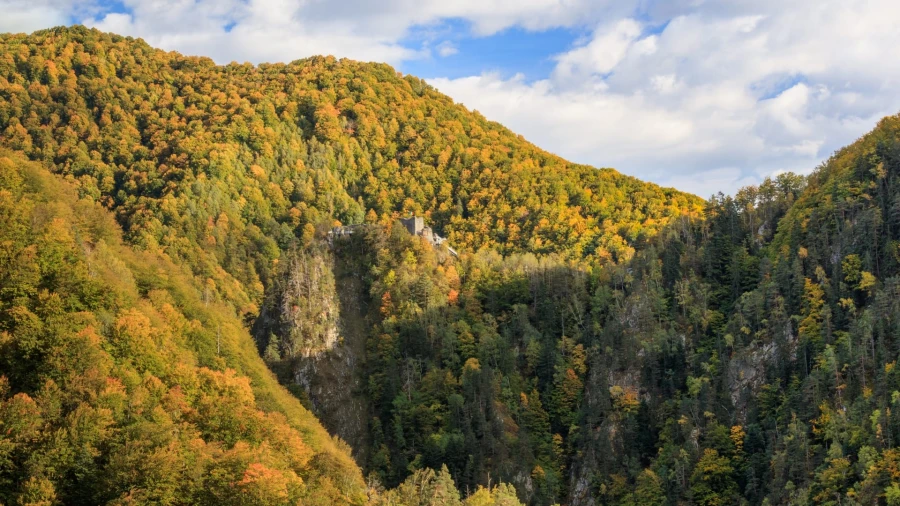
The fortress sits on a rocky peak, Cetățuia Mountain, at an altitude of 850 meters. It offers a spectacular view over the Argeș Valley and is a major point of interest for tourists traveling the famous mountain road.
Access to the fortress starts in Arefu commune, in the village of Căpățânenii Pământeni, where, after passing the Vidraru hydroelectric plant in the Argeș Gorges, you will find the marked tourist trail.
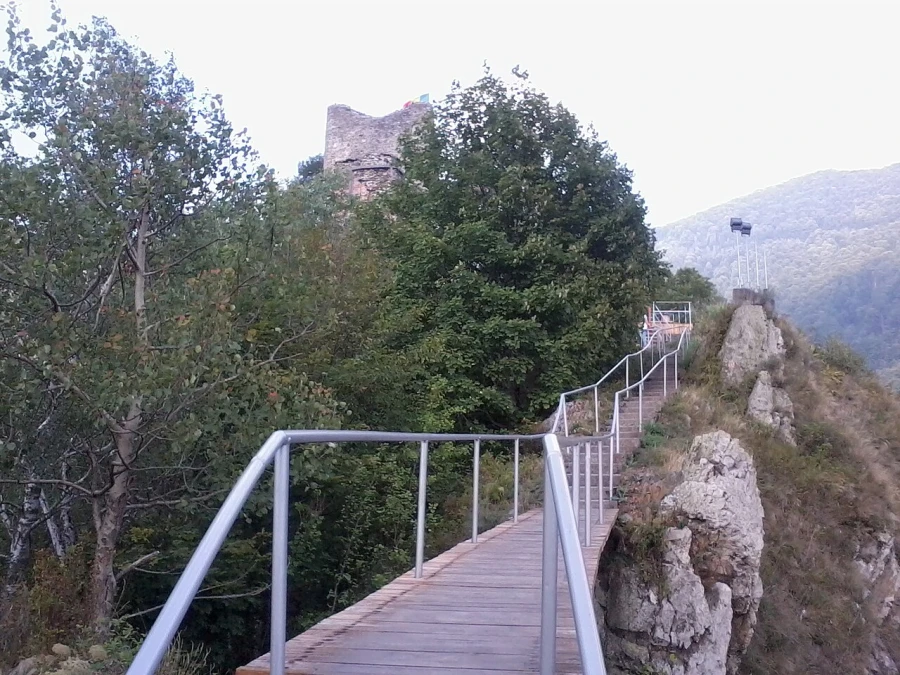
Reaching the fortress means climbing 1,480 steps, a route that takes about 30 minutes. The stairs stretch for almost one kilometer and pass through a beautiful beech forest.
Poenari Fortress – Summer landscape
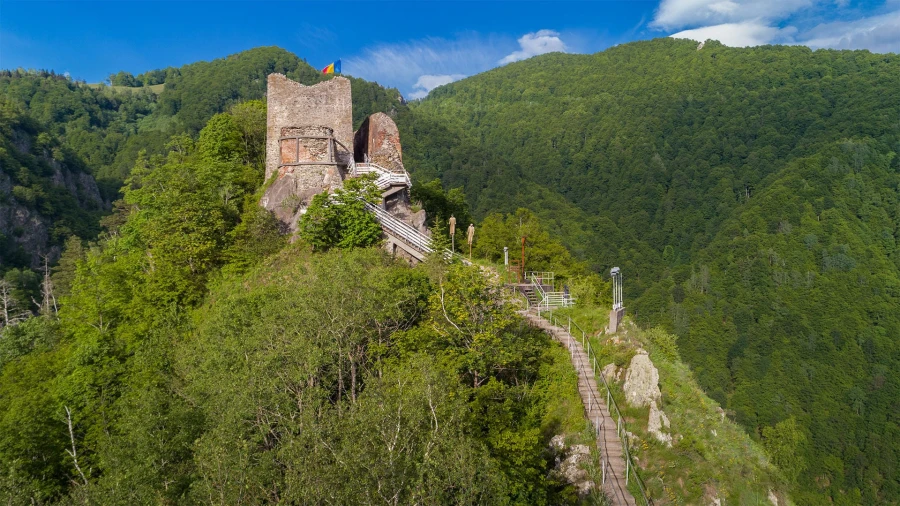
The climb can be demanding, but once you reach the fortress, the effort is rewarded by the impressive panorama.
Distances from several cities to the historic site:
from Argeș: 1 hr 7 min (52.1 km) via DJ703I and Transfăgărășan/DN7C
from Pitești: 1 hr 27 min (67.2 km) via DN7C and Transfăgărășan/DN7C
from Târgoviște: 2 hr 17 min (139.1 km) via A1/E81
from Brașov: 3 hr 45 min (156.0 km) via DN73/E574
from Sibiu: 2 hr 49 min (142.5 km) via DN7/E81
from Făgăraș: 2 hr 50 min (125.4 km) via DN1/E68 and Transfăgărășan/DN7C
History and legends
Poenari Fortress was originally built in the 13th century, on the foundations of older fortifications, with a single square tower and wooden beams, by the ruler Negru Vodă. It was part of Wallachia's defensive system.
Poenari Fortress, alpine winter landscape
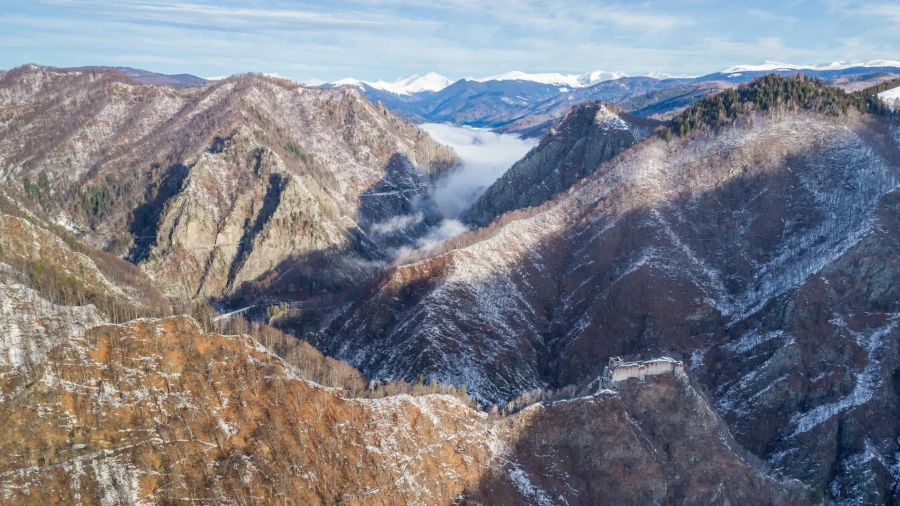
It is believed that this fortification may be Posada, the site of the battle between Basarab I and the King of Hungary, Charles Robert of Anjou. See Wikipedia
In the 15th century, Vlad the Impaler played a key role in renovating and expanding the fortress, which now had 5 towers and walls almost 3 meters thick, turning it into a strategic bastion against the Ottomans. It was his secondary residence.
To do this quickly and efficiently, he is said to have used the forced labor of the boyars of Târgoviște, whom he punished this way for treason.
Legend has it that, after a revolt against him, Vlad the Impaler captured several boyars he considered guilty of treason. Instead of executing them immediately, he forced them to work on rebuilding the fortress for several months. The survivors of the grueling work were released, but many of the boyars lost their lives to exhaustion and the harsh working conditions.
According to another legend, Vlad the Impaler managed to escape the Turks who were chasing him by taking refuge in Poenari Fortress. To confuse his pursuers, he had his horses shod with the horseshoes reversed, misleading them about the direction he had taken.
However, in the 17th century, the fortress began to decline and was abandoned, remaining a ruin, but one of great historical value.
For more details, see the Argeș County Museum
Description of Poenari Fortress
Poenari Fortress is an example of medieval defensive architecture, built on a rocky ridge of the Făgăraș Mountains, at an altitude of over 850 meters.
Its strategic position offers a panoramic view over the Argeș Valley, which made the fortress an essential defensive point in past centuries.
Poenari Fortress seen from above
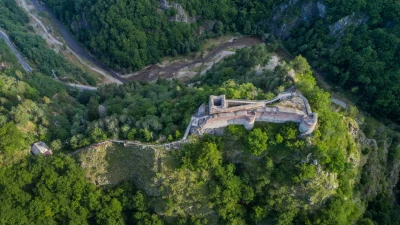
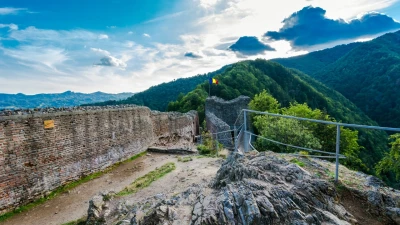
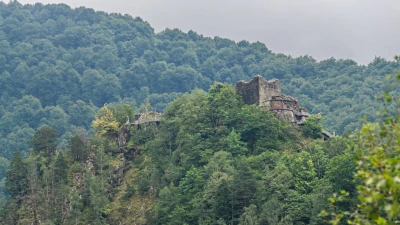
Thick walls and defensive towers
The fortress was designed to withstand enemy attacks, with extremely thick walls (2-3 meters), built of stone and brick. They were meant to provide solid protection against the weapons and siege techniques of the time.
The defensive towers, which watched over the entrance and perimeter of the fortress, were used for observation and for launching attacks against besiegers.
The fortification's position on the steep edge of the mountain made any attempt at a frontal siege difficult.
Length and structure
Poenari Fortress stretches for about 60 meters and was built as a small, elongated fortified perimeter.
The structure is divided into several towers and inner courtyards. A unique feature is the fortress's position on the edge of a rocky cliff. In addition, the fortress served military purposes; it was not an inhabited fortification.
Access to the fortress
Today, the fortification can only be reached by climbing a trail of over 1480 steps, which starts near the national road DN7C-Transfăgărășan.
In medieval times, the steep climb was an important military advantage.
Today, the steps lead visitors to the fortification's gate. At night, the fortification is lit up, and its light looks like a flame on the mountain.
Visiting and tourism
Since November 8, 2021, Poenari Fortress has been closed to the public, undergoing an extensive rehabilitation and restoration process.
Autumn landscape at Poenari Fortress
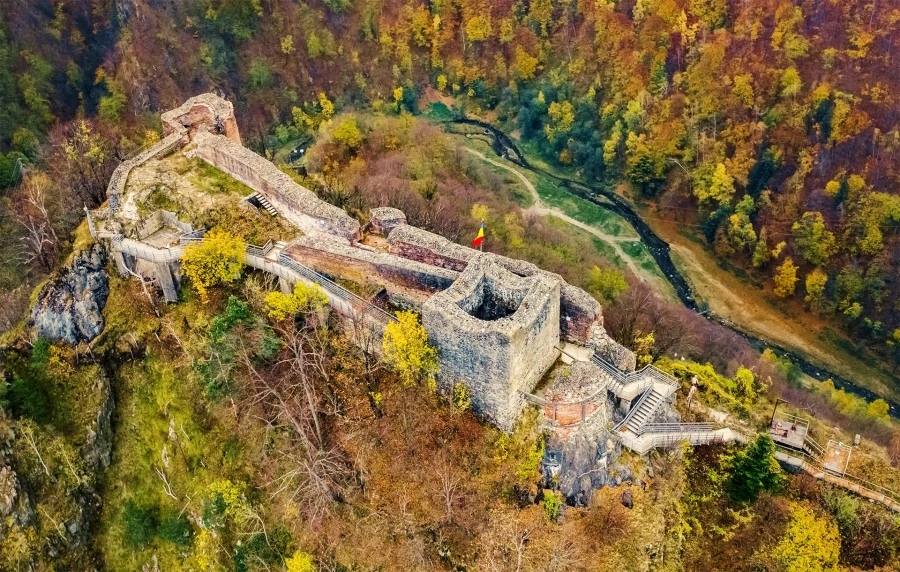
It was expected to reopen this summer (2024), but the work was not completed.
Update May 26, 2025: Poenari Fortress reopens on May 27! Details here
Later edit: The fortress reopened to the public in mid-April 2025, but has been temporarily closed since April 29 because a bear entered the tourist area. See details
Poenari Fortress and its ruins, also known as “Vlad the Impaler's Fortress,” used to attract thousands of tourists every year thanks to its connection with the figure of the ruler and the Dracula myth. See also another place in Romania linked to this character, Tihuța Pass.
Vlad the Impaler and Poenari Fortress
Thanks to its association with Vlad the Impaler and the Dracula myth, the fortress is a major attraction for tourists from all over the world.
Besides Romanian visitors, the fortress attracts foreign tourists (see here), especially from Europe and America, eager to explore the places that inspired the legendary story of Count Dracula.
Foreign media interest (movies, shows, series, documentaries, reports) in Dracula's life has turned the fortress into an essential stop on Romania's cultural tourism map:
“Dracula’s Castle” (National Geographic): The documentary is part of the “Mysteries of the World” series and explores the legends and historical facts related to Dracula. Poenari Fortress is presented as one of the key locations.
“The Real Dracula” (History Channel): The show explores the life of Vlad the Impaler, with a focus on the fortresses associated with him.
“In Search of Dracula” (Discovery Channel): The series explores the legends of Dracula, with episodes dedicated to the fortresses that played an important role in the myth of Vlad the Impaler, including the fortification in Argeș.
“Dracula: Dead and Loving It” (1995): The movie is a comedy and does not focus directly on Poenari Fortress, but it has references to the Dracula legend and its influence on pop culture, including legendary locations associated with Dracula.
“The Vampire’s Tomb”: The horror movie was partly filmed in Romania and includes locations linked to the Dracula myth. The fortress was one of them.
“Exploring the Legend of Dracula” (BBC): The BBC produced a report on the legend of Dracula, in which the fortification is mentioned as one of the important historical locations linked to the ruler's life.
“Vlad the Impaler: The Real Dracula” (Smithsonian Channel): The documentary explores the historical reality behind the legends of Vlad the Impaler and includes footage of the fortress.
“Secretul Castelului lui Dracula” (The Secret of Dracula's Castle): The travel documentary includes a section about the fortress, exploring both its history and the legends associated with it.
These media productions have helped popularize Poenari Fortress as a tourist destination and strengthen its connection with the legend of Vlad the Impaler.
Among the great Romanian intellectuals who wrote about Poenari Fortress are figures such as Nicolae Iorga, Bogdan Petriceicu Hasdeu, Alexandru Vlahuță, Cezar Bolliac, Alexandru Odobescu, and Carol Davila.
Even Jules Verne drew inspiration from the fortress's legends when he wrote The Castle of the Carpathians.
Tourist attractions in the area
The area around Poenari Fortress is rich in natural and cultural attractions, and the road itself, the Transfăgărășan, is a very popular attraction in Romania.
Lake Vidraru and Vidraru Dam
Spectacular landscape with Poenari Fortress and Vidraru Dam
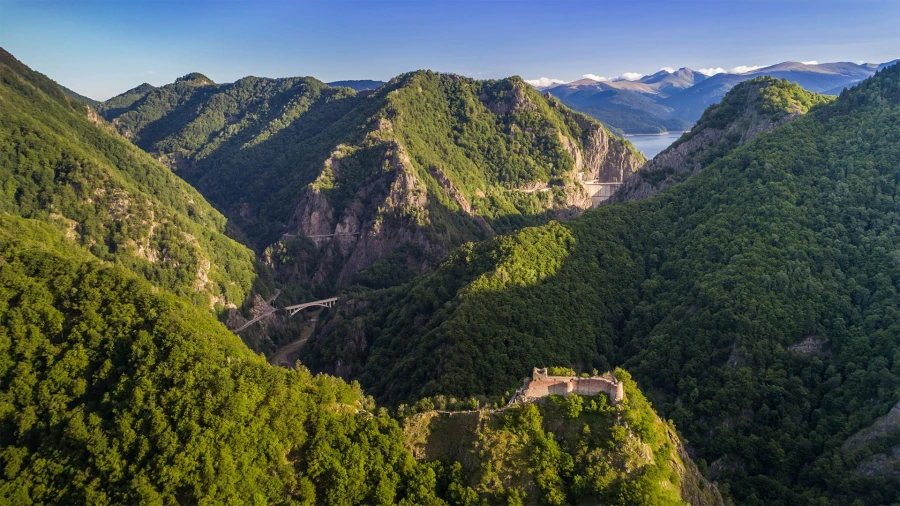
Vidraru Dam, built on the Argeș River in 1965, is one of the most impressive dams in Romania, at 166 meters high. The reservoir created behind it, Lake Vidraru, stretches for 10 km and is an attraction thanks to its remarkable views of the Făgăraș Mountains.
The Transfăgărășan
The Transfăgărășan seen from Poenari Fortress
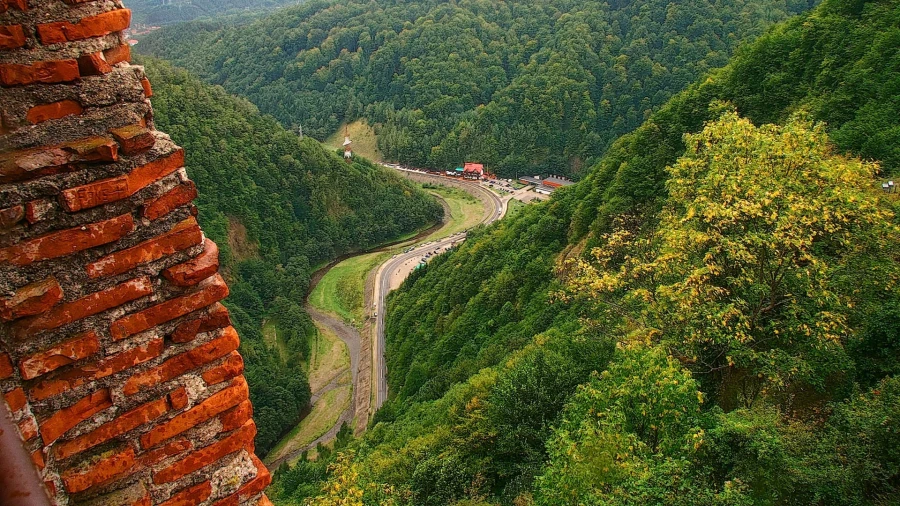
Considered one of the most spectacular mountain roads in the world, the Transfăgărășan crosses the Făgăraș Mountains. The road offers impressive views as it winds among rocks and forests, with panoramic stops at Bâlea Lake and Bâlea Waterfall. See more details.
Corbii de Piatră Monastery
It is a unique cave monastery, carved directly into the rock, dating from the 14th century. It is among the oldest places of worship in Romania and lies in a spectacular natural setting, in an isolated area.
Moldoveanu Peak
Moldoveanu Peak landscape
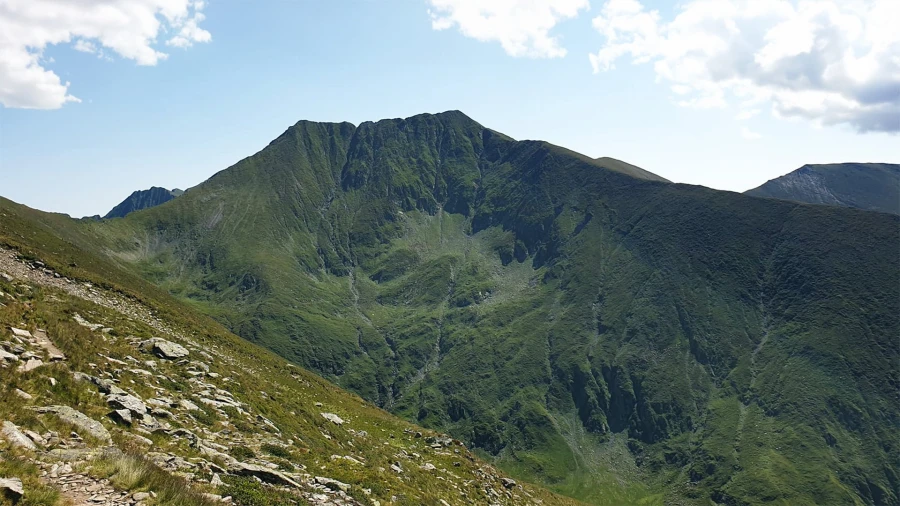
At 2,544 meters, Moldoveanu Peak is the highest peak in Romania and attracts mountain lovers from all over the country.
Albina Peak
Located near Moldoveanu, Albina Peak reaches 2,370 meters and offers a more accessible trail for hikers.
Valea lui Stan
A spectacular canyon on the slopes of the Făgăraș Mountains, Valea lui Stan is known for its hiking trail through narrow gorges and over waterfalls. It includes metal ladders and suspension bridges and is of moderate difficulty.
Curtea de Argeș
The town of Curtea de Argeș is famous for Curtea de Argeș Monastery, where the kings of Romania are buried. Built in the Byzantine style, the monastery is a national symbol, known for the legend of Master Manole.
Accommodation
The area around Poenari Fortress offers a range of accommodation options for all types of travelers.
Near the fortress and Lake Vidraru, tourists can choose between hotels, themed campgrounds, and traditional cabins.
Hotel Posada Vidraru, with panoramic views of the lake, offers all the modern facilities you need for a relaxing vacation, while Dracula Camping offers a unique experience for nature lovers, combining campsites with comfortable bungalows.
For a more authentic atmosphere close to the fortress, Cabana La Cetate offers rustic accommodation in a quiet setting, perfect for those who want to feel the charm of history.
Whatever your preferences, every accommodation in the Poenari Fortress area provides quick access to the main tourist attractions in the heart of the Făgăraș Mountains. See Booking.com
Weather
Weather in Căpățâneni Pământeni today and for the next 7 days:
Frequently asked questions
Is Poenari Fortress open?
Poenari Fortress is currently closed for restoration.
When will Poenari Fortress reopen to the public?
It was expected to reopen this summer (2024), but the work was not completed.
How many steps do you climb to reach Poenari Fortress?
There are 1480 steps up to the fortress.
Conclusion
Poenari Fortress remains an important historical and cultural symbol for Romania.
Closely linked to the figure of Vlad the Impaler, the fortress holds special significance both historically and culturally. Its association with the Dracula myth has brought the fortress international fame, turning it into a must-see attraction for lovers of history, mystery, and legend.
However, the importance of Poenari Fortress goes beyond fiction: it is a place of interest both for historians studying medieval military strategy and for tourists who want to relive the atmosphere of another time in a spectacular natural setting.
We look forward to the reopening of Poenari Fortress!
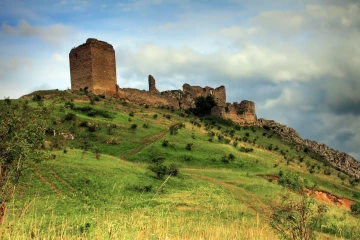
Until then, visit other fortresses in Romania as well: Alba Iulia Citadel, Rupea Fortress, Colțești Fortress, Râșnov Fortress, Sighișoara Citadel.
Stairs to Poenari Fortress. By Elena Avram. Image from Wikipedia, CC BY-SA 3.0 ro