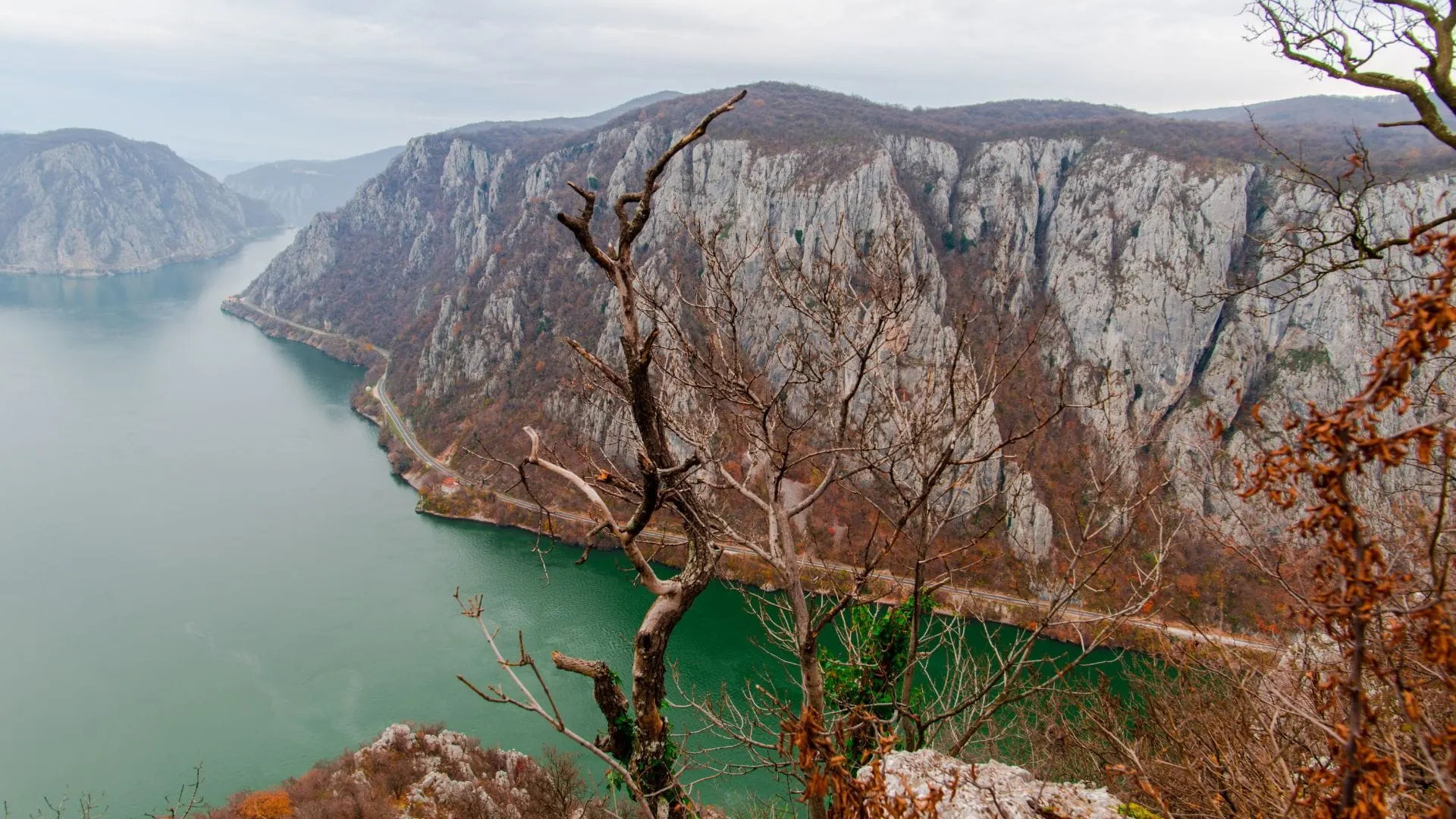
The Danube Gorge (Clisura Dunării), also known in Romanian as Defileul Dunării, is one of the most spectacular and picturesque natural landscapes in Europe.
It is a geographical area on the northern bank of the Danube, between the Nera River and the Cerna River, in southern Banat, within Caraș-Severin and Mehedinți counties.
Located on the border between Romania and Serbia, the region stretches along the Danube River, between Baziaș and Orșova on the Romanian side, offering an impressive sight where the river's waters “cut” through the Carpathian and Balkan mountain ranges.
Population and Localities
The largest towns in the Danube Gorge are Orșova and Moldova Nouă. The Danube Gorge also includes the communes of Socol, Pojejena, Coronini, Gârnic, Sichevița and Berzasca in Caraș-Severin County, as well as Svinița, Dubova, Eșelnița, Ilovița and Breznița-Ocol in Mehedinți County.
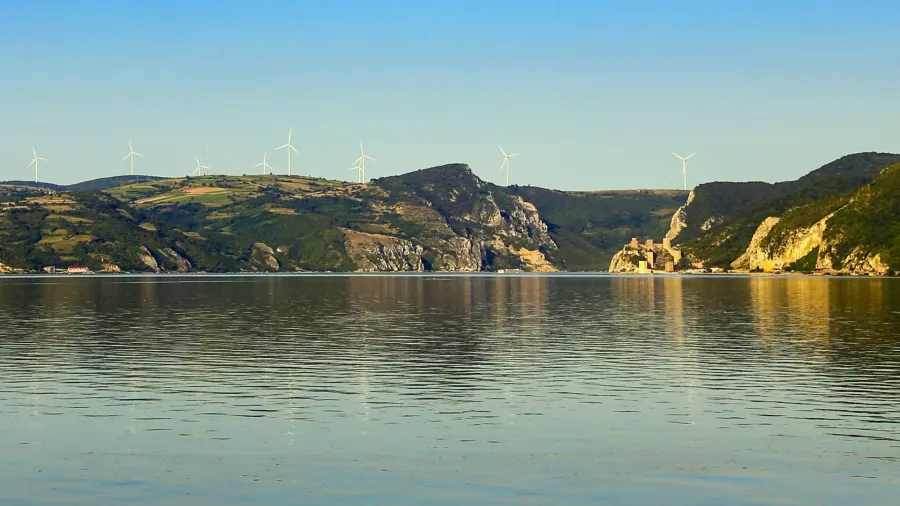
Near Coronini and Golubac – at the entrance to the Iron Gates
The population of the Danube Gorge consists mainly of Romanians and Serbs, with ethnic Serbs forming the majority in some localities, such as Socol, Pojejena and Svinița. There is a Czech community, especially in the villages of Bigăr and Eibenthal, around the commune of Gârnic. Orșova is also home to a significant German community.
The Danube Gorge is a major tourist attraction thanks to its unique landscape, but also because of its ecological, cultural and historical value. Here, the natural beauty of the mountains and the water blends with a rich historical heritage that includes Roman remains, medieval fortresses and natural monuments of global importance.
The region is part of Iron Gates Natural Park, one of the largest and most diverse nature reserves in Romania, which protects exceptional biodiversity. See Wikipedia
Iron Gates Natural Park
Besides adventure tourism and ecotourism, the Danube Gorge attracts visitors interested in history and culture, thanks to monuments of historical and archaeological importance such as the Tabula Traiana and the monumental statue of Decebalus.
Geography of the Danube Gorge
The Danube Gorge is located in southwestern Romania, in Mehedinți and Caraș-Severin counties, on the border with Serbia.
It stretches along the Danube River, which has shaped it, over a distance of about 140 kilometers, between Baziaș and Orșova.
Danube Gorge
The river is one of the most important gateways between Central and Eastern Europe, providing a natural link between the two regions.
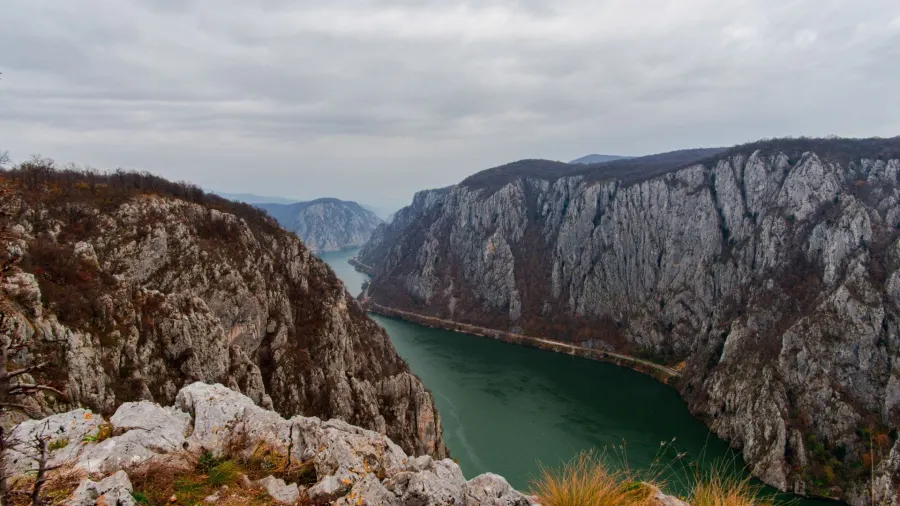
Along the gorge, the Danube changes its course and appearance, shifting from impressive widths to narrow, rocky stretches such as the Great and Small Cauldrons (Cazanele Mari and Cazanele Mici).
The Danube acts as a natural border between Romania and Serbia along the entire gorge. The river separates the two countries but at the same time unites them through a shared landscape of rare beauty. On both banks, you can see spectacular rock formations and diverse vegetation adapted to the harsh conditions of the terrain.
The relief of the Danube Gorge is extremely varied and spectacular. The gorge is bordered by the Carpathian Mountains on the Romanian side and by the Balkan Mountains on the Serbian side, and between these two mountain ranges the Danube carves its way through the rocks, creating steep, rocky landscapes.
The most impressive part of the relief is the area of the Danube Cauldrons (Cazanele Dunării).
Great Cauldrons
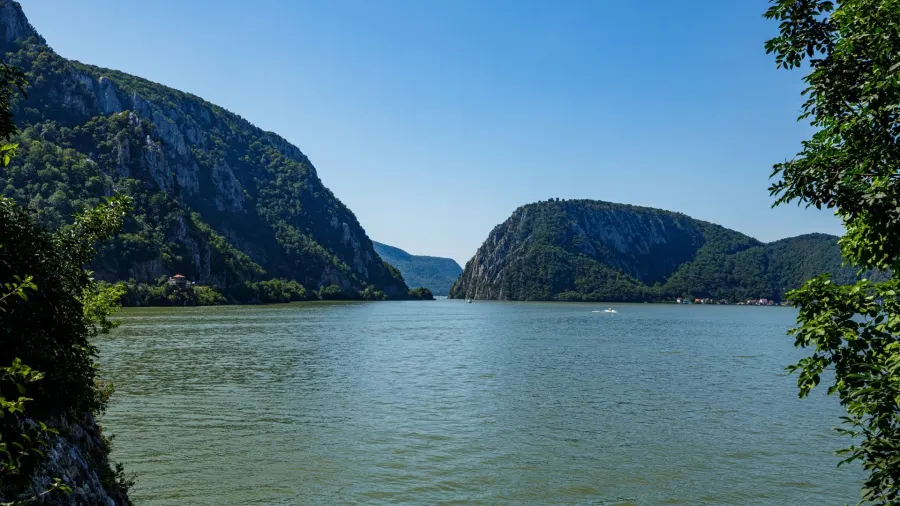
In the Cauldrons area, the river reaches impressive depths of more than 70 meters and narrows to just 150-200 meters wide, creating a cauldron effect, which is where this section of the gorge gets its name.
The diversity of the landscape is another strong point of the Danube Gorge. Besides the rocky relief, the area is dotted with mountain meadows, dense forests and large areas of Mediterranean vegetation.
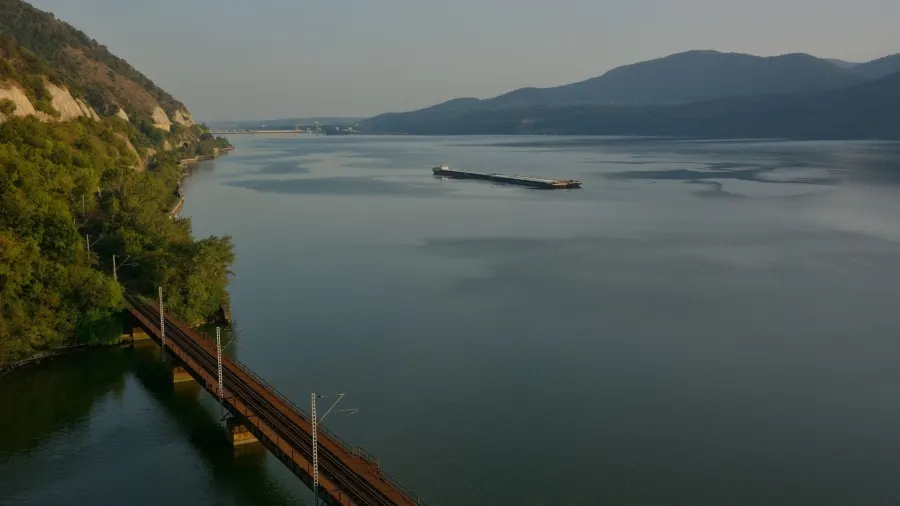
The Danube also plays an essential role in the region's ecosystem and offers opportunities for economic activities such as fishing and navigation.
The hydrographic changes caused by the construction of the Iron Gates Dam partly altered the river's natural course, but the Danube remains a symbol of the region's natural beauty.
History of the Danube Gorge
The name “Clisura Dunării” comes from the Slavic term “klisura,” which means gorge or narrow pass.
The first historical mentions of the area date back to antiquity, when it served as a route of communication and transit between the civilizations of Central Europe and those of the Balkans and the Orient.
Throughout history, the Danube Gorge has played an essential strategic role, becoming a key point for defending borders and developing trade.
In Roman times, the Danube formed a natural frontier between the Roman Empire and the “barbarian” tribes to the north, and the Danube Gorge was a key place for defending the northern border of the Roman Empire.
The Tabula Traiana, a monument left by the Romans on the Serbian bank of the Danube, recalls the importance of this region during Trajan's campaigns against the Dacians.
In the Middle Ages, the area continued to play an important role, serving as a natural border between various empires and kingdoms.
Under Ottoman rule, the Danube Gorge became a commercial and military checkpoint. The river was used to transport goods and to move troops quickly, and the gorge offered a strategic advantage for defense.
Over the centuries, fortresses and fortifications were built along the gorge to protect trade routes and defend territories. One of the best-known medieval fortresses in the area was Severin Fortress, located beyond the eastern end of the gorge, in Drobeta-Turnu Severin.
Construction of the Iron Gates Dam and Its Impact on the Region
A significant event in the contemporary history of the Danube Gorge was the construction of the Iron Gates Dam and reservoir, a huge project carried out jointly by Romania and Yugoslavia (Serbia) between 1964 and 1972.
The hydroelectric dam, one of the largest in Europe, profoundly changed the region's landscape and ecosystem, but it also had a significant impact on local communities.
When the dam was built, the waters of the Danube rose, creating a huge reservoir that improved the river's navigability and became an important source of electricity for both countries.
However, there were also social and ecological consequences. Numerous villages and historic localities in the Danube Gorge were partially or completely submerged, and local populations were forced to move to other areas.
Among these places is Ada Kaleh, an island inhabited by a Turkish community and known for its unique cultural traditions, which was completely flooded after the dam was built.
The Submerged Villages and the Relocation of Local Communities
The construction of the Iron Gates Dam had a devastating impact on some villages in the Danube Gorge.
Among the most affected places was the island of Ada Kaleh, an exotic place inhabited mostly by a Turkish population, which was completely flooded. Ada Kaleh was famous for its culture, its Oriental traditions and its vibrant trade. The local community was relocated, but the spirit of the island lives on in the memories of those who lived there.
Besides Ada Kaleh, other villages in the region were also affected. On the Romanian bank, 10 localities were relocated after being partially or completely flooded (including Orșova Veche, Eșelnița, Tisovița and Jupalnic), plus 7 on the Serbian bank (including Donji Milanovac).
The inhabitants had to be relocated to higher ground or to new settlements created specifically to receive them. This had a profound effect on the cultural and social life of the affected communities, with many traditions and customs being lost or changed as a result of the relocation.
Although the construction of the dam brought many economic and industrial benefits to the region, the sacrifice of these villages and communities remains a tragic part of the history of the Danube Gorge. Their cultural and historical heritage now lies beneath the waters of the Danube, but the memory of those places lives on in the stories of local people and in historical documents.
Tourist Attractions in the Danube Gorge
The Danube Gorge offers visitors many attractions, especially in the area of the Danube Cauldrons.
Danube Cauldrons
The Danube at the Cauldrons is one of the river's most spectacular stretches, extending for almost 9 km. See details here.
Statue of Decebalus
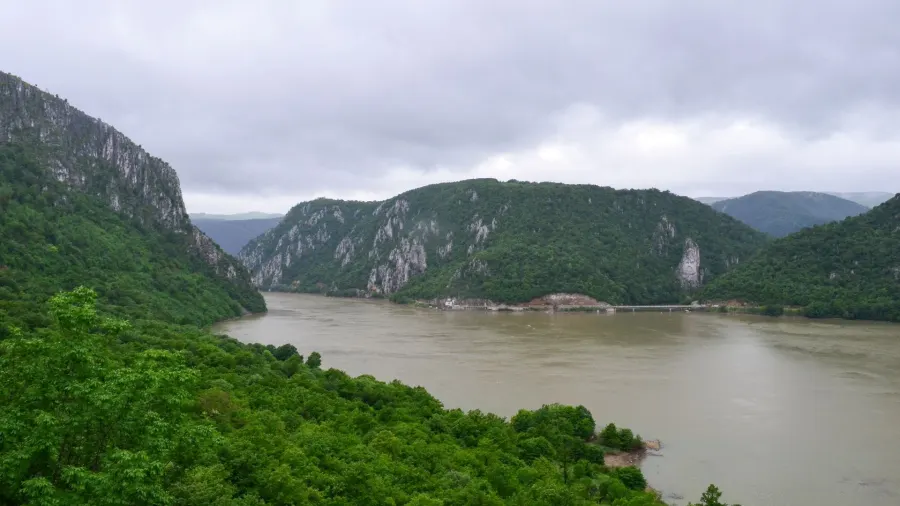
On the Romanian bank of the Danube, at the end of the Small Cauldrons, near Mraconia Bay, stands the face of the Dacian king Decebalus, the largest face carved in stone in Europe, 55 meters high. The huge work, created between 1994 and 2004, pays tribute to the last king of Dacia, Decebalus, a symbol of resistance against the Roman Empire. It is one of the most iconic tourist attractions in the area, drawing visitors from all corners of the world.
Danube Gorge with the Statue of Decebalus
Tabula Traiana
The Roman memorial plaque “Tabula Traiana,” measuring 4 meters wide and 1.75 meters high, marks the completion of the military road built by Emperor Trajan. It is located on the Serbian bank of the Danube. The stone plaque, carved around AD 100, is a symbol of Roman history.
Ponicova and Veterani Caves
The Danube Gorge area is rich in caves, and two of the best known are Veterani Cave and Ponicova Cave.
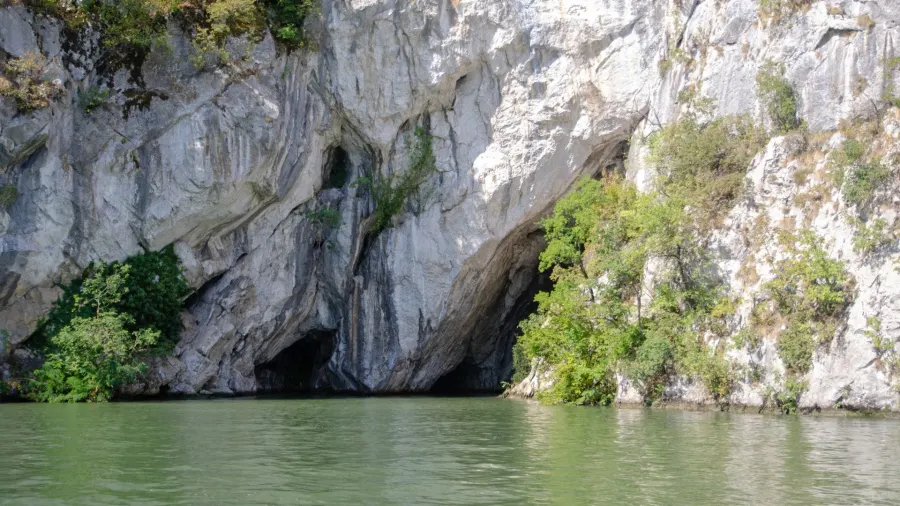
Ponicova Cave, the largest in the Danube Cauldrons, is located about 25 km from Orșova and can be reached both by water and by land.
Veterani Grotto, with a history dating back to Roman times, was used for defensive and strategic purposes. Over time, the cave also served as a refuge for various armies, making it a site of great archaeological and historical interest.
Mraconia Monastery
Mraconia Monastery is located on the bank of the Danube, in a quiet, secluded area, and is known as the “Monastery under the Waters.”
The monastery, whose origins are dated by sources to the 15th–16th centuries, was destroyed and rebuilt several times. The old building was demolished in 1967–1968, when the Iron Gates Dam was built, and the new one was erected in the 1990s. Today, it offers a place of peace and meditation for those visiting the Danube Gorge, as a symbol of faith and resilience.
Iron Gates Natural Park
Iron Gates Natural Park is one of the largest protected areas in Romania, safeguarded for its biodiversity, and covers approximately 115,666 hectares.
The park is home to numerous hiking trails, nature reserves and viewpoints that offer spectacular views of the Danube River and the Cauldrons.
Trikule Fortress
The remains of Trikule Fortress lie partly submerged in the Danube. The fortress is documented from 1419, when King Sigismund of Luxembourg entrusted its defense against the Ottoman Empire to the Teutonic Knights.
It was built to control navigation on the Danube and to defend the border against the Ottoman Empire. Today you can still see the ruins of two of the fortress's towers, which add a touch of mystery and historical charm to the area.
Trikule Fortress stands on the bank of the Danube, near the village of Svinița, Mehedinți County, in southwestern Romania. The medieval fortification is located in the Danube Gorge, upstream of the Danube Cauldrons, and is part of a series of fortifications built along the river to defend the borders against Ottoman invasions.
Severin Fortress
Beyond the eastern end of the Danube Gorge, in Drobeta-Turnu Severin, Severin Fortress is another important tourist attraction. The medieval fortress, built in the 13th century, played a crucial role in defending Christendom against the Ottoman invasion. The fortress has been partially restored with European funds.
Moldova Veche Island
Moldova Veche Island (Ostrovul Moldova Veche), located on the Danube, is a special place for nature lovers and birdwatchers.
The island, part of Iron Gates Natural Park, is protected for its unique flora and fauna and is an important refuge for migratory birds and other rare species.
Moldova Veche Island lies in the Danube River, opposite the village of Moldova Veche, which is part of the town of Moldova Nouă, in Caraș-Severin County, on the border between Romania and Serbia. It is part of Iron Gates Natural Park as a protected wetland that is important for birds.
Trescovăț Peak
Trescovăț Peak is one of the most impressive viewpoints in Iron Gates Natural Park. At an altitude of about 755 meters, the peak offers spectacular views of the Danube and its gorge.
The hiking trail is generally easy, except for the steep climb up the eastern slope of the mountain. From the top, a panorama opens over the hills on both banks of the Danube, as far as the Czech village of Ravensca.
Babacaia Rock
Babacaia Rock (Babakaj in Serbian) is an iconic feature of the Danube Gorge area: it rises from the river's waters at the entrance to the gorge, opposite the village of Coronini and Golubac Fortress on the Serbian bank.
It is only a few meters high, and in the Middle Ages a chain stretched to it from Golubac Fortress that could block navigation on the Danube.
The Danube Gorge is not just a dreamlike landscape but also a tourist destination rich in history and culture, offering visitors many points of interest.
These include Vodița Monastery, one of the oldest monasteries in Romania, and St. Anne Monastery, known for its tranquility and natural beauty. In addition, Gornea Monastery is home to an active monastic community, while the Roman Catholic Cathedral in Orșova impresses with its unique architecture.
Drobeta-Turnu Severin is also home to the Iron Gates Region Museum, which presents the history and nature of the region, while at Gura Văii, near the dam, there is the Iron Gates I Hydropower Plant Museum, where visitors can learn about the technology used to generate electricity.
The Art Museum (a former residence of the Ceaușescu couple) and the Gornea Village Museum offer insight into local traditions and culture, while Gura cu Muscă Cave, near Coronini, known as the breeding ground of the Golubatz fly, offers opportunities for caving.
Last but not least, the watermills of Sichevița, more than 20 of them, some still in working order, add a special charm to this place and offer a glimpse into traditional methods of grinding grain, all contributing to the charm and tourist diversity of the Danube Gorge.
In addition, 2 large national parks with many other natural attractions are nearby: Cheile Nerei-Beușnița National Park and Domogled-Valea Cernei National Park.
Accommodation in the Danube Gorge
There are many tourist offers and places to stay along the Danube Gorge route, and many of the guesthouses are on the banks of the Danube, with pontoons.
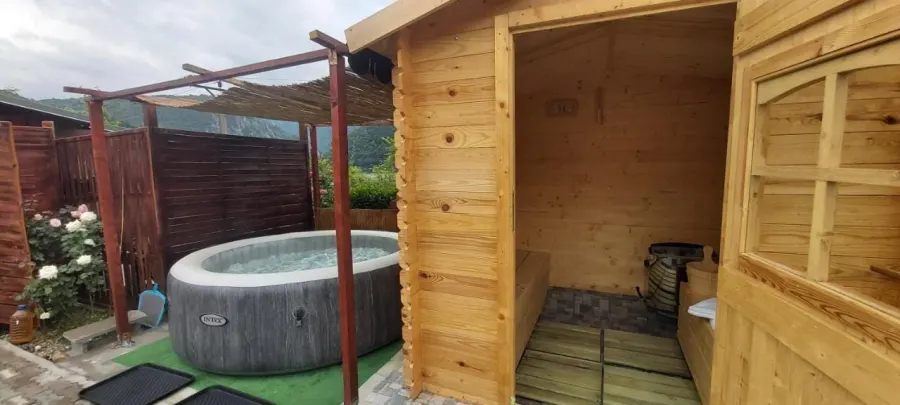
Căsuțele Danca in Ogradena are very popular for the authentic experience they offer. Details here
Căsuțele Danca
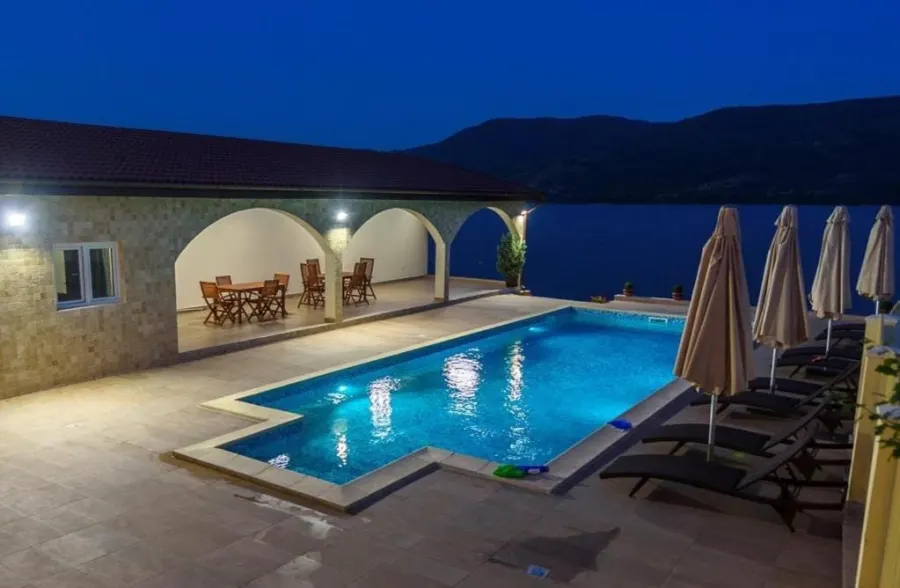
Pensiunea Alex & Restaurant is located in Eșelnița and offers services that visitors appreciate. Details here
Pensiunea Alex & Restaurant
The village of Dubova and Dubova Bay offer many accommodation options. Casa de vacanță Alexandra și Adan offers 4 rooms for your stay and relaxation. Details here
Casa de vacanță Alexandra și Adan
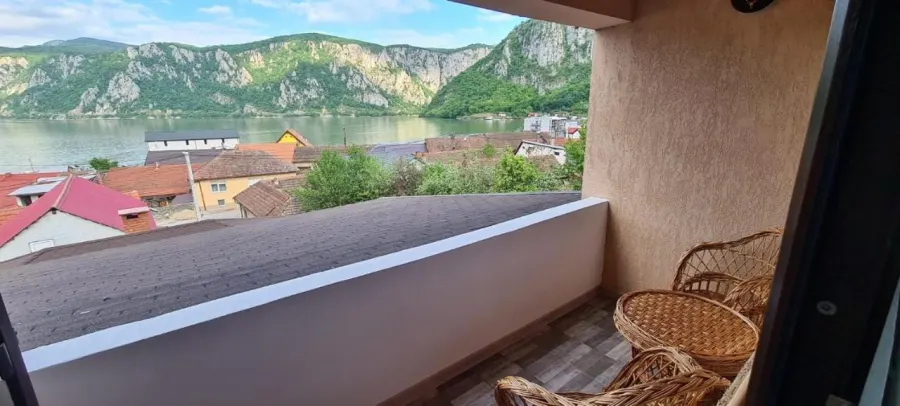
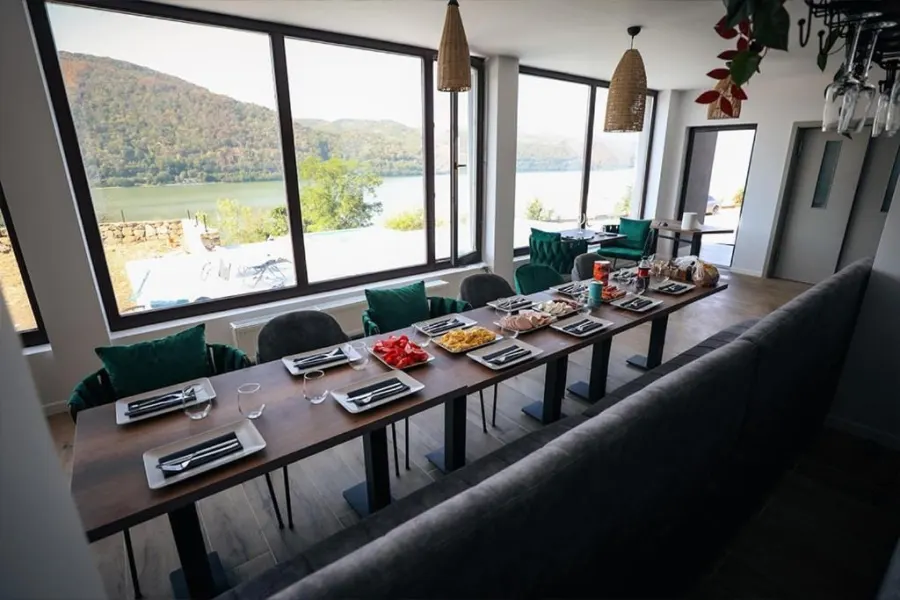
Pensiunea Berzasca offers 4-star accommodation and a restaurant. Details here
Pensiunea Berzasca
Travel Tips
How to Get to the Danube Gorge
The most convenient way to reach the Danube Gorge is by road. If you are coming from Bucharest, you can take national road DN6 (E70) to Drobeta-Turnu Severin and Orșova, and from there continue on DN57 into the gorge itself.
You can also get there from Timișoara via DN59 and DN57.
If you prefer, you can arrive by boat on the Danube, departing from river ports such as Orșova or Moldova Nouă. Danube cruises are also a popular option for tourists, offering a unique perspective on the area.
Best Time to Visit
The Danube Gorge is an attractive destination all year round, but the ideal time to explore the region is from spring to early fall, between April and October.
During these months, the weather is milder, and recreational activities such as hiking and Danube cruises are more accessible.
May and September in particular are ideal for those who want to avoid the crowds of the summer tourist season.
Other Useful Information
Admission fees for tourist attractions in the Danube Gorge vary. For example, visiting Ponicova Cave or Veterani Cave may involve a small fee, depending on the type of tour (guided or self-guided).
Ponicova Cave from the outside
Danube cruises also vary in price depending on their duration and itinerary. To fully enjoy this area, it is a good idea to consult local guides or join organized tours, which will give you relevant historical and ecological details. Many of these tours also include stops at the major attractions.
Flora and Fauna of the Danube Gorge
The Danube Gorge, part of Iron Gates Natural Park, is an area particularly rich in biodiversity.
The fauna is extremely diverse and includes:
Mammals: wolves, wild boars, roe deer and lynxes.
Birds: greater spotted eagles, herons, cormorants and various species of ducks and geese.
Reptiles and amphibians: snakes, turtles and various species of frogs.
Fish: catfish, carp and pike, commonly found in the waters of the Danube. Migratory sturgeons have no longer been able to swim up into the gorge since the Iron Gates dams were built, and the river's aquatic ecosystems need greater protection to maintain the region's natural balance.
The Danube Gorge is a region rich in rare and endemic species, with vegetation that reflects a mix of continental and Mediterranean climatic influences:
Deciduous forests: oak, beech and hornbeam.
Rare plants: the Cazane tulip (Tulipa hungarica), the Banat pink (Dianthus banaticus), the Banat black pine and the bellflower Campanula crassipes.
Rock vegetation: various species of mosses and lichens, adapted to the rocky conditions of the gorge.
Activities in the Danube Gorge
Danube cruises are an excellent way to explore the Danube Gorge and the Cauldrons. They often include stops at points of interest such as Mraconia Monastery and the statue of Decebalus, the largest rock sculpture in Europe, located near Mraconia Bay.
You can go hiking on mountain trails to spectacular viewpoints. The Danube Cauldrons area offers many spectacular mountain trails, including the trails to the Ciucaru Mare and Ciucaru Mic peaks.
The Danube and the nearby lakes are ideal for water sports, kayaking, sport fishing and rowing.
Sport fishing is also very popular, with many competitions organized every year. Fishing is a traditional activity in the Danube Cauldrons area. The most sought-after species include carp, catfish and pike. Fishing rules are strict in order to protect biodiversity and include closed seasons and catch limits.
Two of the most popular trails are:
1. Ciucăr Terrace – Ciucaru Mare Peak Trail
One of the most spectacular trails in the area is the one that climbs Ciucaru Mare Peak. From here, a unique panorama opens over the Great Cauldrons.
The trail starts from DN57, at the exit from Dubova toward Moldova Veche (Ciucăr Terrace), is marked with a yellow triangle and has a medium difficulty level (only the first part is steep). It takes about 2 hours.
2. Trail to Trescovăț Peak
For those who want a long hike, the trail to Trescovăț Peak is an option. It offers stunning views of the Danube and its surroundings.
The trail starts from the Stariște tourist point on DN57, about 6 km from Svinița toward Berzasca, and has viewpoints roughly every half hour of walking. It takes around 8 hours.
Local Cuisine in the Danube Gorge
One of the central elements of the cuisine in the Danube Gorge is fish, caught directly from the waters of the Danube, which is the basis of the most popular local recipes. Fish soup (ciorbă de pește) is one of the region's signature dishes, known for its rich flavor, which comes from a combination of fish such as catfish, carp or pike, seasoned with fresh herbs and served with polenta (mămăligă).
Fish saramură is another culinary delight typical of the area, made from fish roasted over an open fire and served with a spicy sauce of tomatoes, garlic and hot peppers. Each recipe has a distinct local touch.
The Danube Gorge lies on the border between Romania and Serbia, which is reflected in the local cuisine, a true cultural blend. Romanian and Serbian influences intertwine harmoniously, so visitors can taste traditional dishes from both cultures.
The Danube Gorge is not only a region of ecological importance but also a cultural and historical space of deep significance. Located on the border between Romania and Serbia, the gorge has been a meeting place of civilizations throughout history, reflecting a rich cultural heritage. The Romanian and Serbian communities in the area have shared traditions, customs and beliefs that have given rise to a common cultural legacy.
Weather in Orșova
The weather in Orșova now and for the next 7 days:
Conclusion
The Danube Gorge is an impressive region. From the spectacular landscapes of the Great and Small Cauldrons to the Roman historical monuments and the churches on the banks of the Danube, the area offers countless reasons to visit. The statue of Decebalus, the Tabula Traiana and the hidden caves are just a few of the attractions that fascinate tourists.
Beyond its appeal for tourists, the Danube Gorge has remarkable ecological importance. Iron Gates Natural Park protects a diverse range of plant and animal species, some of them unique in Europe. Add it to your travel list!
Also, don't miss the resorts on the Romanian coast, near the place where the Danube flows into the Black Sea.